
Page
Free Harmony Week Printables and Activities
70 free original Harmony Week resources and a 50-page activity pack for Foundation–Year 6: colouring, games, puzzles, crafts and belonging worksheets.
Free original activities for Australian primary schools, OSHC services, families, libraries and community groups. Choose from 70 resources with A4 PDFs, colour and black-and-white editions, previews and separate answers or educator notes.
What is Harmony Week?
Harmony Week celebrates cultural diversity, respect, inclusion and belonging. The official message is Everyone belongs. It includes 21 March, the International Day for the Elimination of Racial Discrimination. Read official information.
The official site’s published 2026 dates were 16–22 March. Reviewed 2 October 2026; check harmony.gov.au for the next announced dates. Student artwork has no event year.
Start with the 50-page activity pack
The curated pack includes complete selected activities, two layouts of each bingo game plus calling references, an eight-page folding passport and a short educator guide. Individual downloads contain all bingo layouts and enlarged display variants.
- 50-page colour activity pack
- 50-page black-and-white activity pack
- Separate pack answers and educator notes
- Factual source booklet
Choose a pack
- Harmony Week Crafts: Colour · Black and white · Educator notes
- Harmony Week Worksheets: Colour · Black and white · Educator notes
- Harmony Week Activities for Primary School: Colour · Black and white · Educator notes
- Harmony Week Activities for OSHC: Colour · Black and white · Educator notes
- Harmony Week Friendship Activities: Colour · Black and white · Educator notes
- Harmony Week Colouring Pages: Colour · Black and white · Educator notes
- Harmony Week Early Years Pack: Colour · Black and white · Educator notes
- Harmony Week Years 5–6 Pack: Colour · Black and white · Educator notes
Belonging & Friendship
- My Belonging Shield — Foundation–Year 6. Draw four parts of an optional personal or fictional belonging shield.
- Everyone Is Unique — Years 3–4. Read six fictional profiles and find shared and different interests.
- Find Something We Share — Foundation–Year 6. Find eight shared interests by talking, pointing or using fictional profiles.
- Friendship Bingo — Foundation–Year 6. Play with twelve different interest bingo cards and optional conversation prompts.
- What Does Belonging Feel Like? — Foundation–Year 6. Choose feeling words and draw a moment of belonging.
- How Can We Help Everyone Belong? — Foundation–Year 6. Plan welcoming responses to four fictional group situations.
- Kind Words and Unkind Words — Foundation–Year 6. Sort nine speech cards and rewrite unhelpful words.
- Welcome a New Student — Foundation–Year 6. Make an original welcome card for a fictional new student.
- Finish the Sentence — Years 3–4. Finish six welcoming and respectful sentence starters.
- What Is Discrimination? — Years 5–6. Explore fair treatment and discrimination using fictional scenarios.
- Speak Up Safely — Years 5–6. Practise safe ways to support someone whose accent is mocked.
- Stereotype or Fact? — Years 5–6. Distinguish checked information from sweeping fictional assumptions.
- Same, Different, Both — Years 3–4. Use fictional interest sets to find similarities and differences.
- Compliment Cards — Foundation–Year 6. Give specific, kind feedback using six sentence cards.
- Community Circle Questions — Foundation–Year 6. Use forty optional discussion questions across two age levels.
- What Makes a Community Inclusive? — Years 5–6. Evaluate six fictional community situations and suggest improvements.
- Inclusion Problem Solver — Years 5–6. Solve five fictional access and inclusion challenges.
- Culture Is More Than Food and Flags — Years 5–6. Build a concept map showing culture beyond food and flags.
- Assumptions and Respectful Questions — Years 5–6. Rewrite six broad fictional assumptions as optional respectful questions.
Cultural Learning
- Hello Around the World — Years 3–4. Match eight language names to verified daytime greetings.
- Thank You Around the World — Years 3–4. Match eight languages to verified ways to say thank you.
- Languages Around Us — Years 3–4. Notice languages in books, signs and other everyday sources.
- Design a Welcome Sign — Foundation–Year 6. Design an original welcoming sign with an optional researched greeting.
- Cultural Curiosity Cards — Foundation–Year 6. Use thirty optional conversation cards about learning, interests and community.
- Foods Around the World Matching — Years 3–4. Match nine illustrated foods to names and explore carefully qualified connections.
- My Favourite Food — Foundation–Year 6. Draw a favourite or imaginary food and explain your choice.
- Build a Harmony Picnic — Foundation–Year 6. Choose six of twenty food cards for an inclusive imaginary picnic.
- Recipe Interview — Years 3–4. Interview a willing adult, role-play or use a published recipe.
- Games Around the World — Foundation–Year 6. Explore twelve sourced games and discuss accessible ways to play.
- Compare Two Games — Years 3–4. Compare the equipment, goals and movements of two games.
- Invent a Game Everyone Can Play — Foundation–Year 6. Design and test an accessible game with clear, fair rules.
- Music Around the World — Years 3–4. Explore eight illustrated musical instruments and their varied connections.
- Instrument Matching — Years 3–4. Match instrument pictures, names and descriptions across two levels.
- Our World Map — Years 3–4. Use an accurate coastline map to mark places to learn about.
- Around the World Scavenger Hunt — Years 3–4. Use books or supervised sources to find seven examples and record sources.
- Australia Is Home to Many Stories — Years 3–4. Add optional interests or imaginary community stories to an Australia outline.
- World Flag Matching — Years 3–4. Match twelve checked vector flags to country names using numbered cards.
- Design a Friendship Flag — Years 3–4. Design a flag using three colours, two symbols and a motto.
Colouring Pages
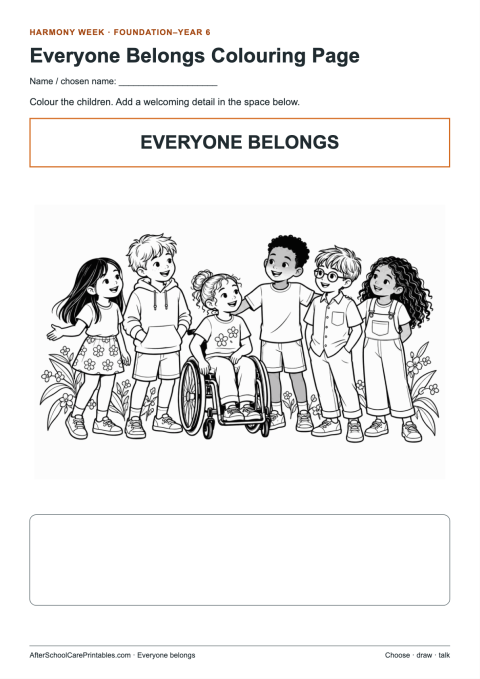
- Everyone Belongs Colouring Page — Foundation–Year 6. Colour an original group of children and add a welcoming detail.
- Harmony Week Colouring Poster — Foundation–Year 6. Colour a celebration poster, or assemble an enlarged classroom display.
- Harmony Pattern Drawing — Foundation–Year 6. Fill six original geometric pattern spaces without copying cultural designs.
- Harmony Mosaic — Foundation–Year 6. Complete a fifty-section mosaic and an enlarged shared display.
- Everyone Belongs Early Years Colouring — Foundation–Year 2. Colour a simplified early years group with large open spaces.
Games & Puzzles
- Harmony Week Word Search — Years 3–4. Find twelve belonging and respect words in a checked word search.
- Harmony Week Crossword — Years 3–4. Solve a connected eight-word crossword with separate clues and key.
- Harmony Week I Spy — Years 3–4. Count exact objects in a code-built illustrated activity scene.
- Harmony Week Maze — Foundation–Year 6. Follow a checked maze from New Friend to Welcome.
- Harmony Week Spot the Difference — Years 3–4. Find ten controlled differences between two original community scenes.
- Harmony Week Bingo — Foundation–Year 6. Play twelve different picture bingo layouts with a complete calling reference.
- Harmony Week Memory Cards — Foundation–Year 6. Match twelve concept pairs in twenty-four memory cards.
- Harmony Week Scavenger Hunt — Foundation–Year 6. Complete eight inclusive Harmony Week search tasks.
- Early Years Kind and Unkind Sorting — Foundation–Year 2. Sort six visual kind and unkind action cards.
- Friendship Matching — Foundation–Year 2. Match six friendship pictures with identical pairs.
- Find the Orange Objects — Foundation–Year 2. Find five orange objects using colour or labelled patterns.
- Different Faces, Same Feelings — Foundation–Year 2. Match diverse fictional faces to expressions and discuss how feelings vary.
- Early Years Friendship Maze — Foundation–Year 2. Trace an easier, checked friendship maze.
Crafts
- Harmony Hand Tree — Foundation–Year 6. Build an original hand tree with A4, A3 and hand templates.
- Harmony Paper Chain — Foundation–Year 6. Write welcoming actions on four paper chain strips.
- Everyone Belongs Wristbands — Foundation–Year 6. Colour and assemble two adjustable belonging wristbands.
- Friendship Flower — Foundation–Year 6. Make a six-petal flower showing ways to include others.
- Harmony Week Bookmarks — Foundation–Year 6. Colour and cut four original belonging bookmarks.
- Our Group Belongs Poster — Foundation–Year 6. Contribute an optional symbol or word to a shared group poster.
- Belonging Wall — Foundation–Year 6. Build a wall of welcoming actions with printable bricks.
- Harmony Week Activity Passport — Foundation–Year 6. Fold an eight-page passport with six activity stations.
- Harmony Week Event Certificates — Foundation–Year 6. Choose from five original certificates with editable writing spaces.
- Harmony Week Photo Booth Props — Foundation–Year 6. Make nine original photo props, with participation and photos optional.
Primary School
- Everyone Is Unique — Years 3–4. Read six fictional profiles and find shared and different interests.
- Hello Around the World — Years 3–4. Match eight language names to verified daytime greetings.
- Thank You Around the World — Years 3–4. Match eight languages to verified ways to say thank you.
- Languages Around Us — Years 3–4. Notice languages in books, signs and other everyday sources.
- Foods Around the World Matching — Years 3–4. Match nine illustrated foods to names and explore carefully qualified connections.
- Recipe Interview — Years 3–4. Interview a willing adult, role-play or use a published recipe.
- Compare Two Games — Years 3–4. Compare the equipment, goals and movements of two games.
- Music Around the World — Years 3–4. Explore eight illustrated musical instruments and their varied connections.
- Instrument Matching — Years 3–4. Match instrument pictures, names and descriptions across two levels.
- Our World Map — Years 3–4. Use an accurate coastline map to mark places to learn about.
- Around the World Scavenger Hunt — Years 3–4. Use books or supervised sources to find seven examples and record sources.
- Australia Is Home to Many Stories — Years 3–4. Add optional interests or imaginary community stories to an Australia outline.
- Harmony Week Word Search — Years 3–4. Find twelve belonging and respect words in a checked word search.
- Harmony Week Crossword — Years 3–4. Solve a connected eight-word crossword with separate clues and key.
- Harmony Acrostic Poem — Years 3–4. Write a positive HARMONY acrostic in seven generous spaces.
- Finish the Sentence — Years 3–4. Finish six welcoming and respectful sentence starters.
- Harmony Story Starter — Years 3–4. Write a fictional story about a new student and an important object.
- Harmony Week I Spy — Years 3–4. Count exact objects in a code-built illustrated activity scene.
- Harmony Week Spot the Difference — Years 3–4. Find ten controlled differences between two original community scenes.
- Same, Different, Both — Years 3–4. Use fictional interest sets to find similarities and differences.
- World Flag Matching — Years 3–4. Match twelve checked vector flags to country names using numbered cards.
- Design a Friendship Flag — Years 3–4. Design a flag using three colours, two symbols and a motto.
- My Favourite Things — Foundation–Year 2. Draw four favourite or imaginary interests in large spaces.
- Helping Hands — Foundation–Year 2. Trace a hand and draw one action that helps someone belong.
Early Years
- Everyone Belongs Early Years Colouring — Foundation–Year 2. Colour a simplified early years group with large open spaces.
- Early Years Kind and Unkind Sorting — Foundation–Year 2. Sort six visual kind and unkind action cards.
- Friendship Matching — Foundation–Year 2. Match six friendship pictures with identical pairs.
- Find the Orange Objects — Foundation–Year 2. Find five orange objects using colour or labelled patterns.
- Different Faces, Same Feelings — Foundation–Year 2. Match diverse fictional faces to expressions and discuss how feelings vary.
- Early Years Friendship Maze — Foundation–Year 2. Trace an easier, checked friendship maze.
- My Favourite Things — Foundation–Year 2. Draw four favourite or imaginary interests in large spaces.
- Helping Hands — Foundation–Year 2. Trace a hand and draw one action that helps someone belong.
Years 5–6
- What Is Discrimination? — Years 5–6. Explore fair treatment and discrimination using fictional scenarios.
- Speak Up Safely — Years 5–6. Practise safe ways to support someone whose accent is mocked.
- Stereotype or Fact? — Years 5–6. Distinguish checked information from sweeping fictional assumptions.
- What Makes a Community Inclusive? — Years 5–6. Evaluate six fictional community situations and suggest improvements.
- Inclusion Problem Solver — Years 5–6. Solve five fictional access and inclusion challenges.
- Culture Is More Than Food and Flags — Years 5–6. Build a concept map showing culture beyond food and flags.
- Assumptions and Respectful Questions — Years 5–6. Rewrite six broad fictional assumptions as optional respectful questions.
OSHC Activities
- Everyone Belongs Colouring Page — Foundation–Year 6. Colour an original group of children and add a welcoming detail.
- Harmony Week Colouring Poster — Foundation–Year 6. Colour a celebration poster, or assemble an enlarged classroom display.
- Find Something We Share — Foundation–Year 6. Find eight shared interests by talking, pointing or using fictional profiles.
- Friendship Bingo — Foundation–Year 6. Play with twelve different interest bingo cards and optional conversation prompts.
- Cultural Curiosity Cards — Foundation–Year 6. Use thirty optional conversation cards about learning, interests and community.
- Build a Harmony Picnic — Foundation–Year 6. Choose six of twenty food cards for an inclusive imaginary picnic.
- Games Around the World — Foundation–Year 6. Explore twelve sourced games and discuss accessible ways to play.
- Invent a Game Everyone Can Play — Foundation–Year 6. Design and test an accessible game with clear, fair rules.
- Harmony Pattern Drawing — Foundation–Year 6. Fill six original geometric pattern spaces without copying cultural designs.
- Harmony Mosaic — Foundation–Year 6. Complete a fifty-section mosaic and an enlarged shared display.
- Harmony Week I Spy — Years 3–4. Count exact objects in a code-built illustrated activity scene.
- Harmony Week Maze — Foundation–Year 6. Follow a checked maze from New Friend to Welcome.
- Harmony Week Spot the Difference — Years 3–4. Find ten controlled differences between two original community scenes.
- Harmony Week Bingo — Foundation–Year 6. Play twelve different picture bingo layouts with a complete calling reference.
- Harmony Week Memory Cards — Foundation–Year 6. Match twelve concept pairs in twenty-four memory cards.
- Harmony Hand Tree — Foundation–Year 6. Build an original hand tree with A4, A3 and hand templates.
- Harmony Paper Chain — Foundation–Year 6. Write welcoming actions on four paper chain strips.
- Everyone Belongs Wristbands — Foundation–Year 6. Colour and assemble two adjustable belonging wristbands.
- Friendship Flower — Foundation–Year 6. Make a six-petal flower showing ways to include others.
- Harmony Week Bookmarks — Foundation–Year 6. Colour and cut four original belonging bookmarks.
- Our Group Belongs Poster — Foundation–Year 6. Contribute an optional symbol or word to a shared group poster.
- Belonging Wall — Foundation–Year 6. Build a wall of welcoming actions with printable bricks.
- Compliment Cards — Foundation–Year 6. Give specific, kind feedback using six sentence cards.
- Community Circle Questions — Foundation–Year 6. Use forty optional discussion questions across two age levels.
- Harmony Week Activity Passport — Foundation–Year 6. Fold an eight-page passport with six activity stations.
- Harmony Week Scavenger Hunt — Foundation–Year 6. Complete eight inclusive Harmony Week search tasks.
- Harmony Week Event Certificates — Foundation–Year 6. Choose from five original certificates with editable writing spaces.
- Harmony Week Photo Booth Props — Foundation–Year 6. Make nine original photo props, with participation and photos optional.
Use a welcoming approach
Offer choices, quiet options and seated participation. Children may invent examples, draw, point, use a scribe or pass. Personal or family information is never required. No tasting or photos are needed. Cultural examples do not describe everyone in a place or group.
Independent original resources, with per-item source notes. This collection complements official information and does not reproduce official branding or worksheets.