Resource
Indoor Camping Activity Pack
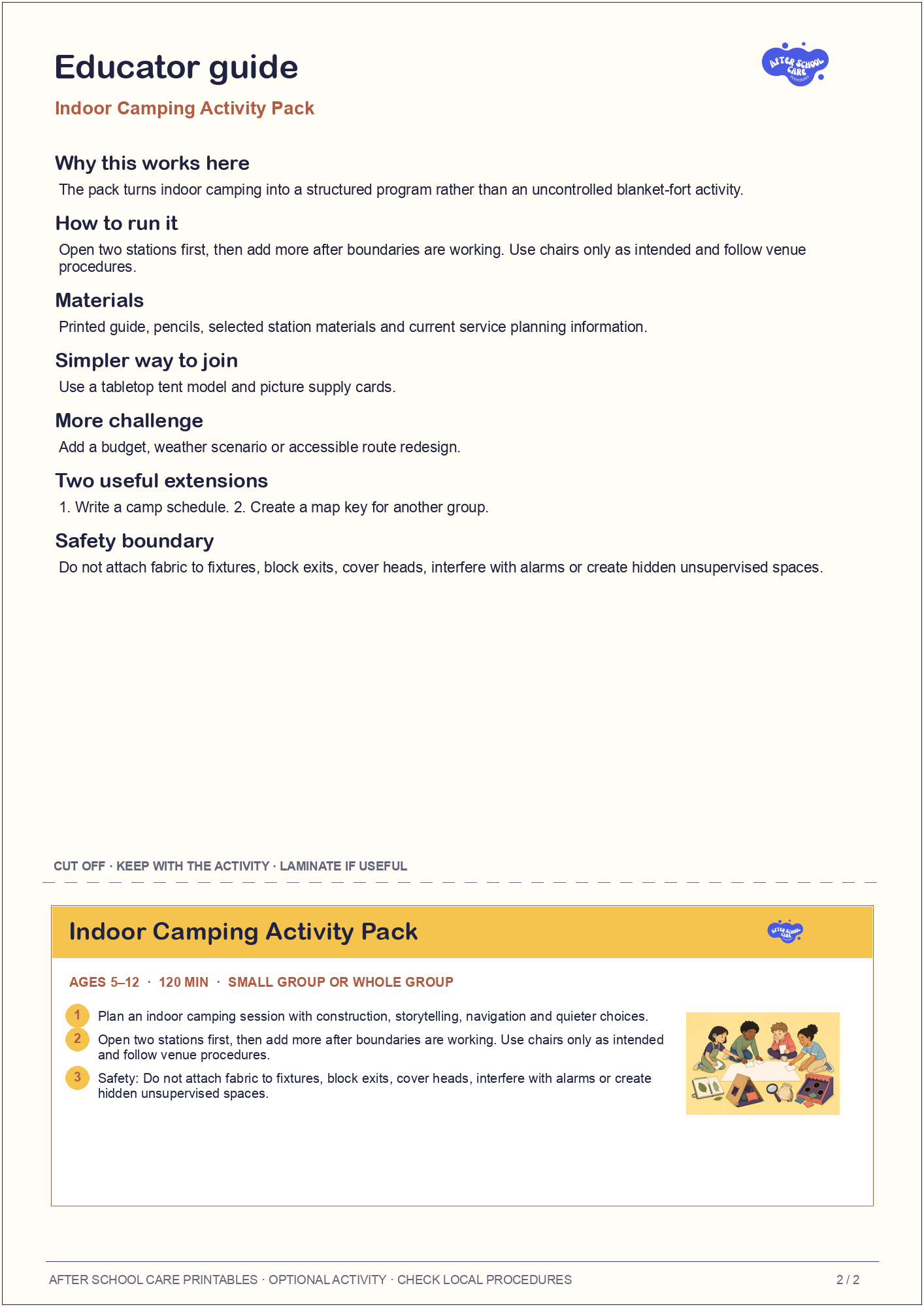
Plan an indoor camping session with construction, storytelling, navigation and quieter choices. Includes an 11-page pack in A4 and Letter, with station materials, educator guidance and individual page downloads.
Ready for a real OSHC session
Preview all 11 printable pages
Download 11-page practical printableCheck the preview, printing notes and licence before use.
When this resource is useful
The pack supplies the maps, drawing spaces and cards needed for a pretend indoor camping session, alongside educator instructions and a timed example.
What children do
Choose stations and roles. Make tabletop paper shelter models; use the supplied cards for pretend supplies, stories and routes.
Materials and preparation
Materials: A4 or Letter paper, pencils, scrap paper or clean lightweight card, tape, optional books and counters. Adults can cut the printed cards in advance; scissors are optional. Picture supplies are pretend items, not a requirement to bring real camping equipment.
Allow about 20 minutes to print and place the resource. The activity itself usually takes 120 minutes and can pause when the group needs to transition.
Run the activity
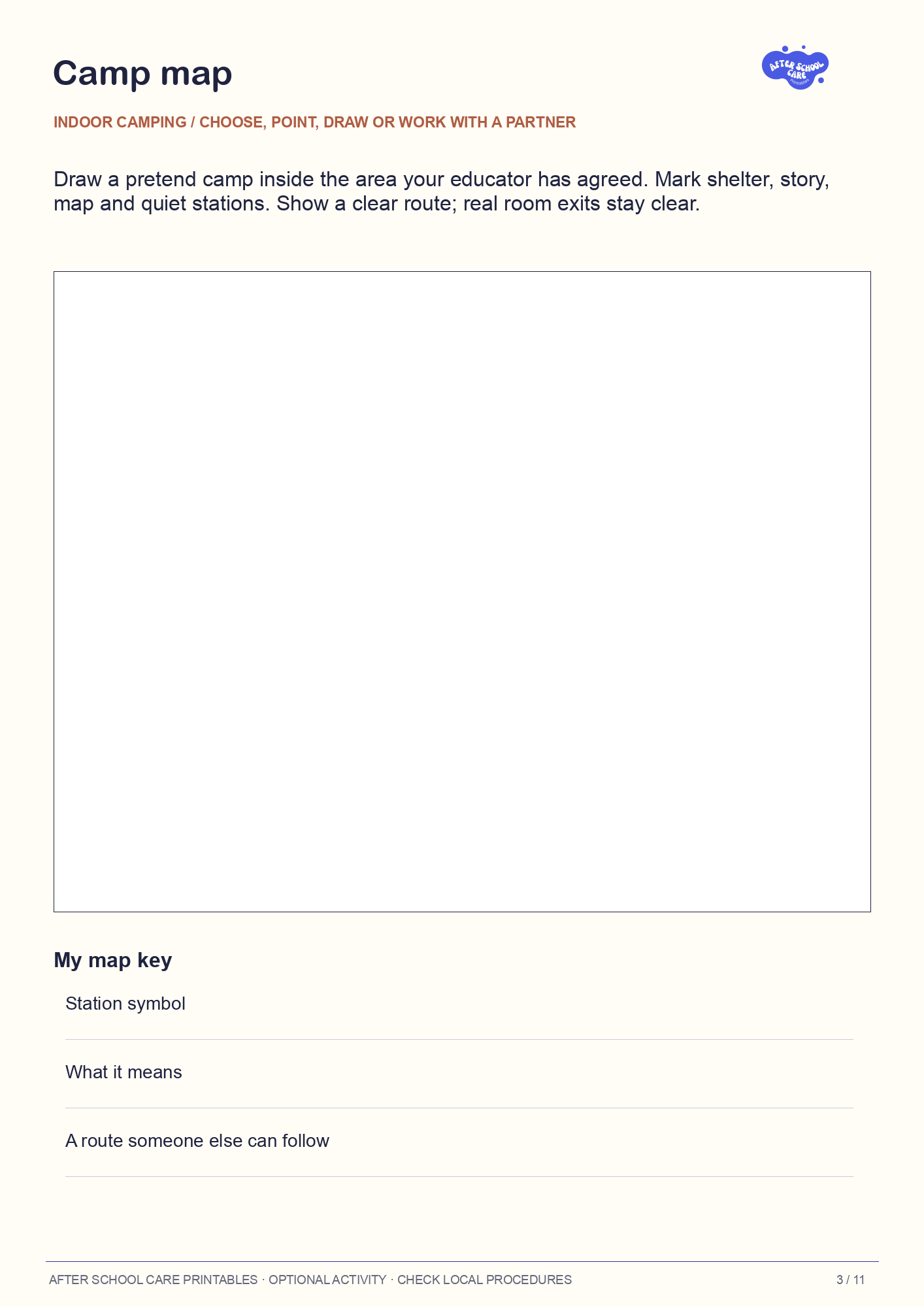
Start with the camp map and a tabletop shelter model. Use the supplied picture, story, route and message cards for the stations that fit today. Offer reading or drawing throughout. Page 11 gives preparation and a 120-minute example; adjust it to attendance and space.
The child-facing prompts are:
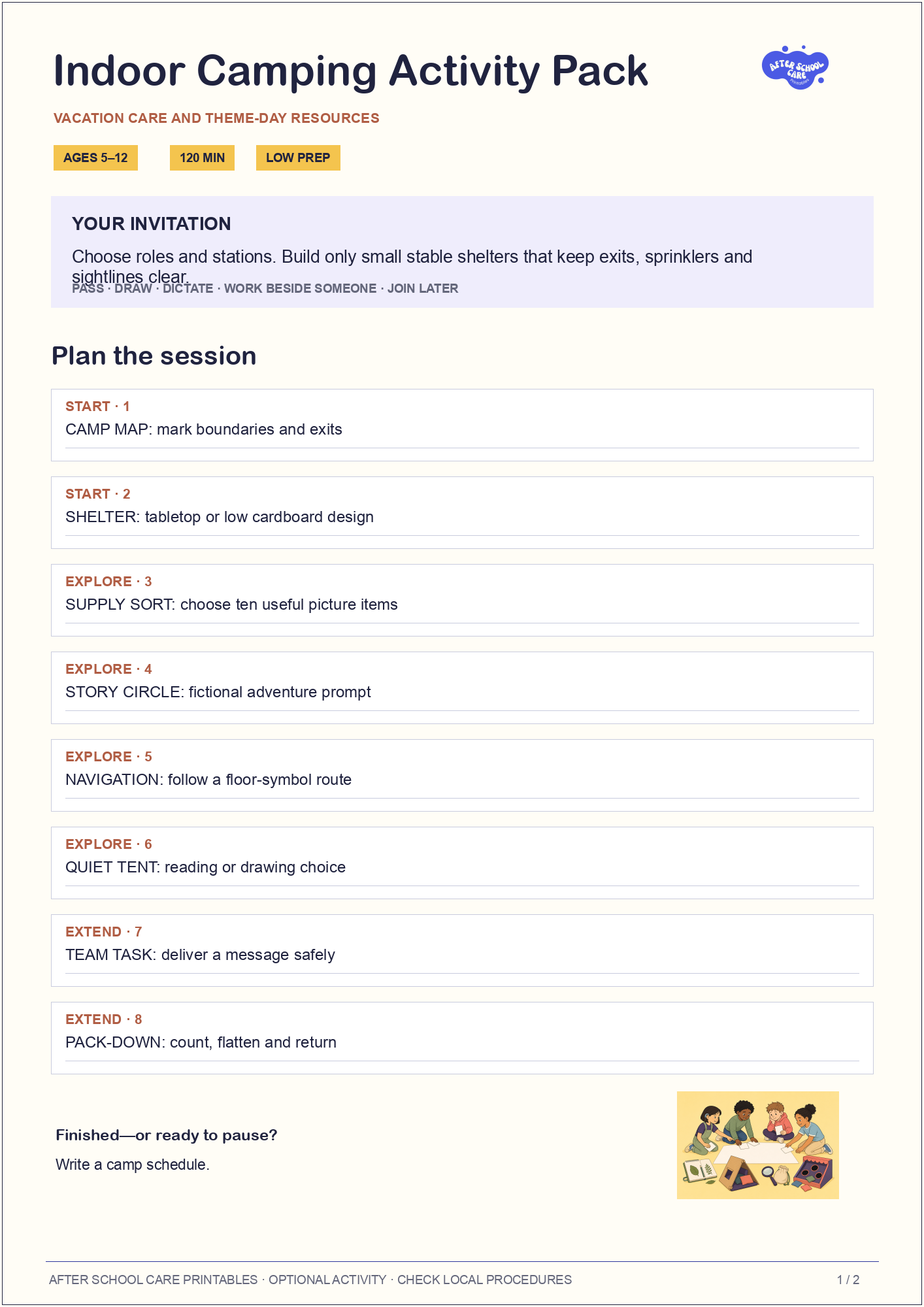
- CAMP MAP: mark boundaries and exits
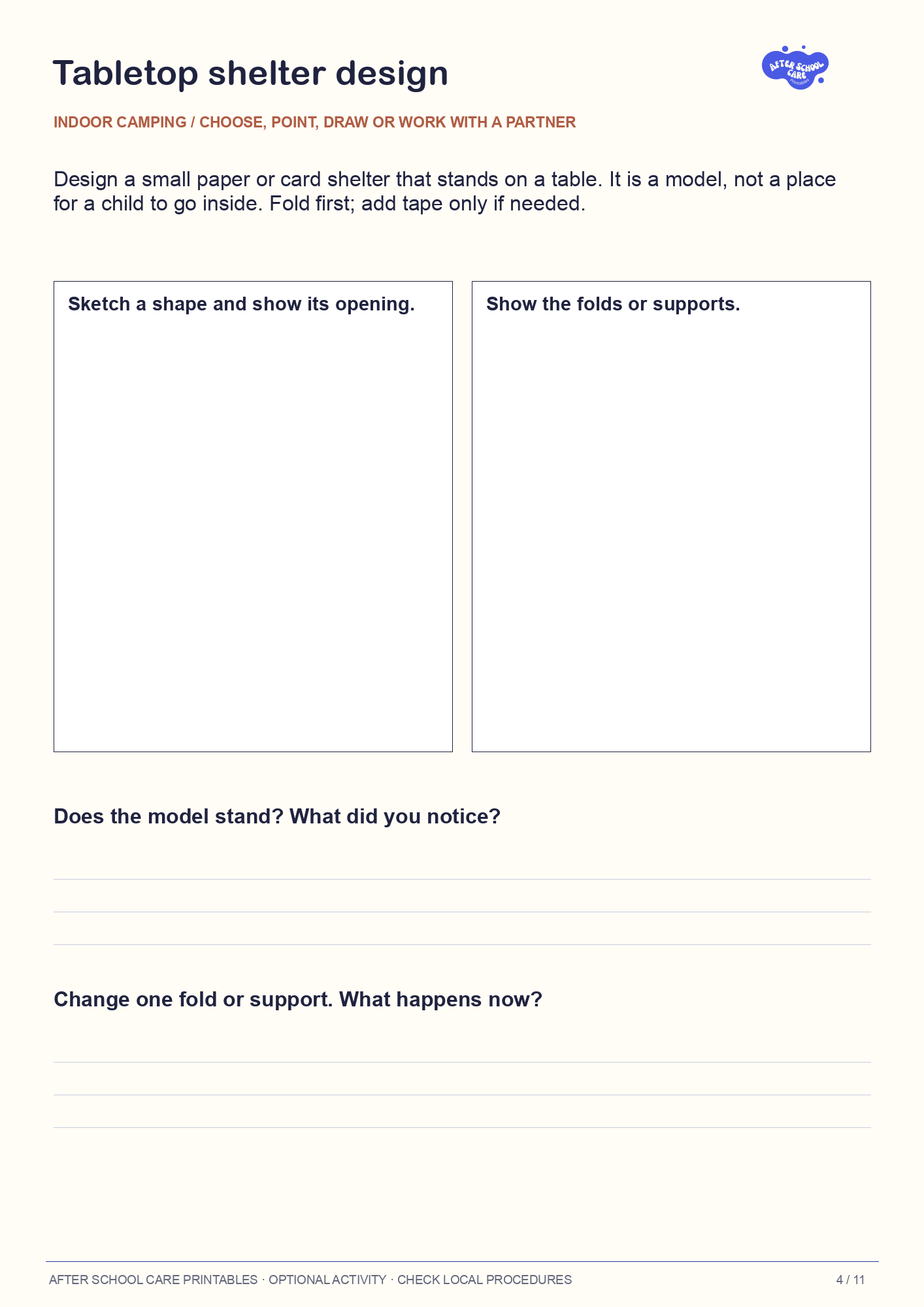
- SHELTER: tabletop or low cardboard design
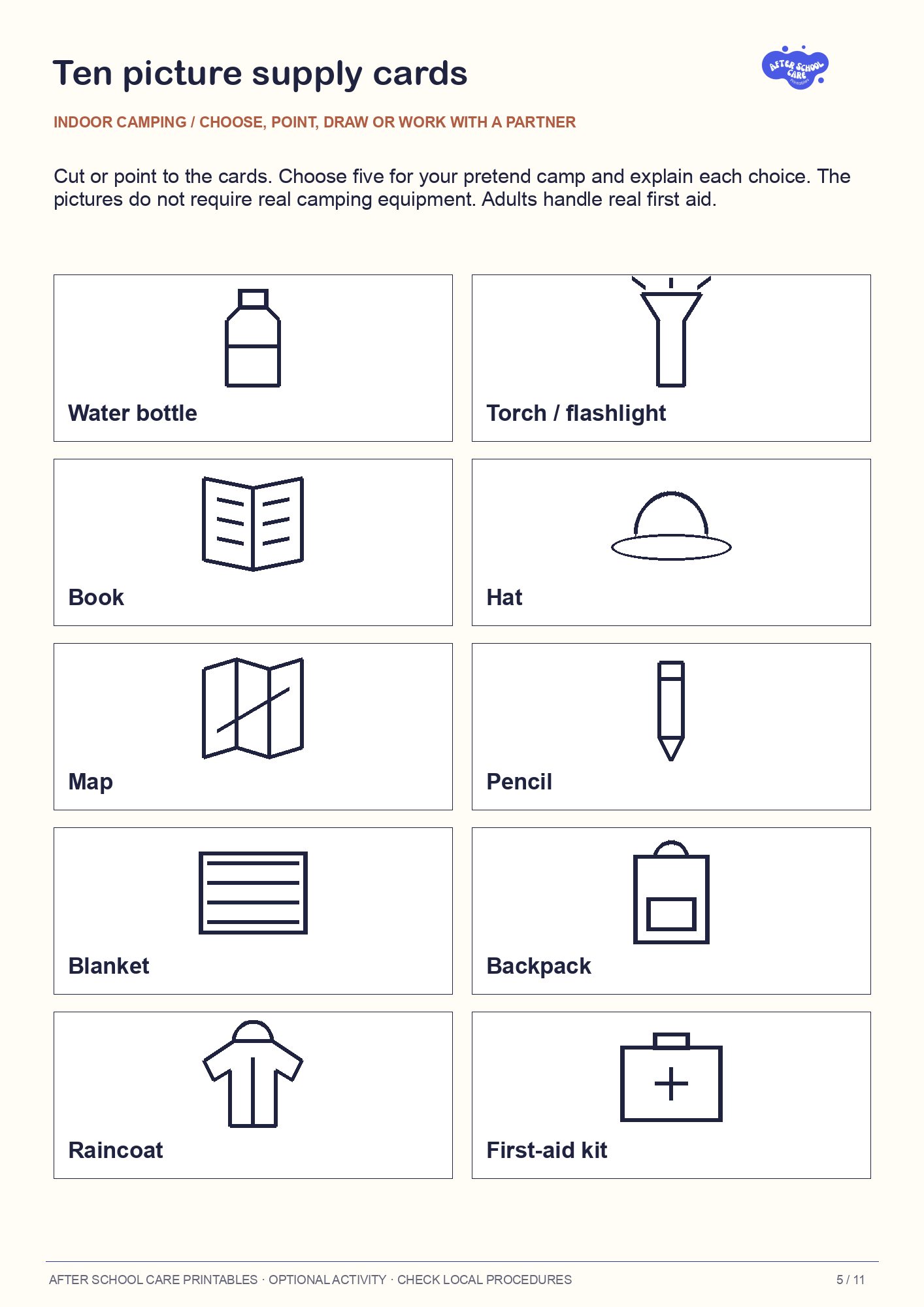
- SUPPLY SORT: choose five of ten picture cards
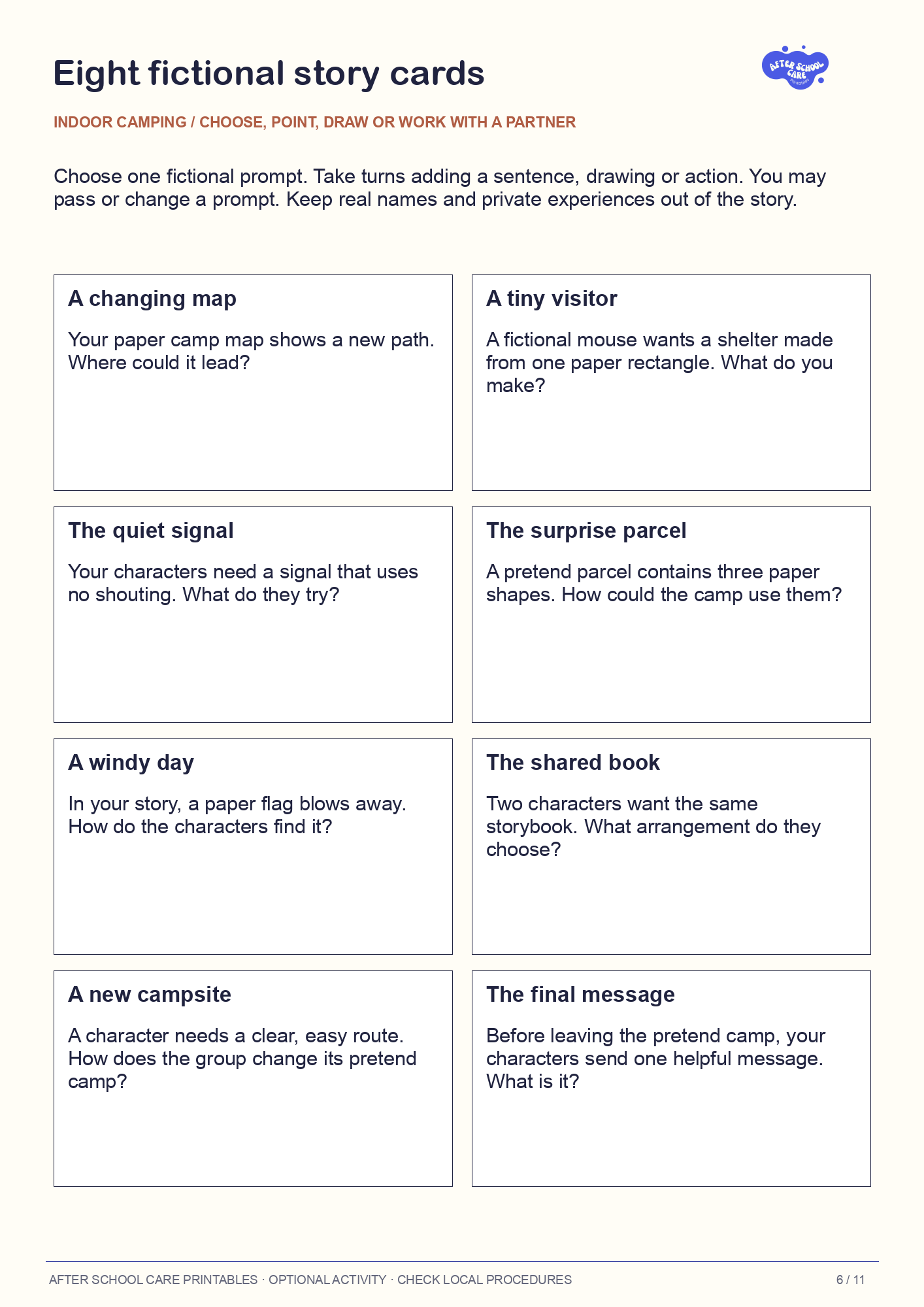
- STORY CIRCLE: fictional adventure prompt
- NAVIGATION: follow a floor-symbol route
- QUIET CORNER: reading or drawing choice
- TEAM TASK: deliver a message safely
- PACK-DOWN: count, flatten and return
Adapt participation
Simpler way to join: Use a tabletop tent model and picture supply cards.
More challenge: Add a budget, weather scenario or accessible route redesign.
Children may draw, dictate, point, work beside a peer, observe or join later. Use the station planner first; the extra pages supply the maps, drawing spaces and cards. Children may stay with a quiet choice or help with equipment and message roles.
Extend the idea
- Write a camp schedule.
- Create a map key for another group.
Safety and privacy
Keep real exits, sightlines, alarms and fixtures clear. Build tabletop models only; do not attach fabric to furniture or fixtures or cover anyone’s head. Use pictures for supply sorting. The first-aid-kit picture is a pretend planning choice, not permission to open or use real medical supplies. Adults manage any cutting and room movement under local procedures.
Learning opportunities
Look for program participation, planning, collaboration and reflection. Record what children choose, explain, test or revise rather than treating completion as proof of learning.
Checking an open-ended response
There is no single required answer. A useful response follows the printed condition and can be explained, demonstrated or revised by the child.
Printing notes
Choose the A4 or Letter edition and print at actual size. Page 1 is the station planner, page 2 is educator guidance, pages 3–10 supply activity materials, and page 11 gives preparation and a timed example. Individual page PDFs are A4; for Letter, select pages from the full Letter pack. The PDFs contain page images; the written web instructions can be selected or read with assistive technology.
Complete pack and individual pages
- Complete 11-page Letter pack
- Two-page station overview
- Page 1: Station planner
- Page 2: Educator guide and reference card
- Page 3: Camp map
- Page 4: Tabletop shelter design
- Page 5: Ten picture supply cards
- Page 6: Eight fictional story cards
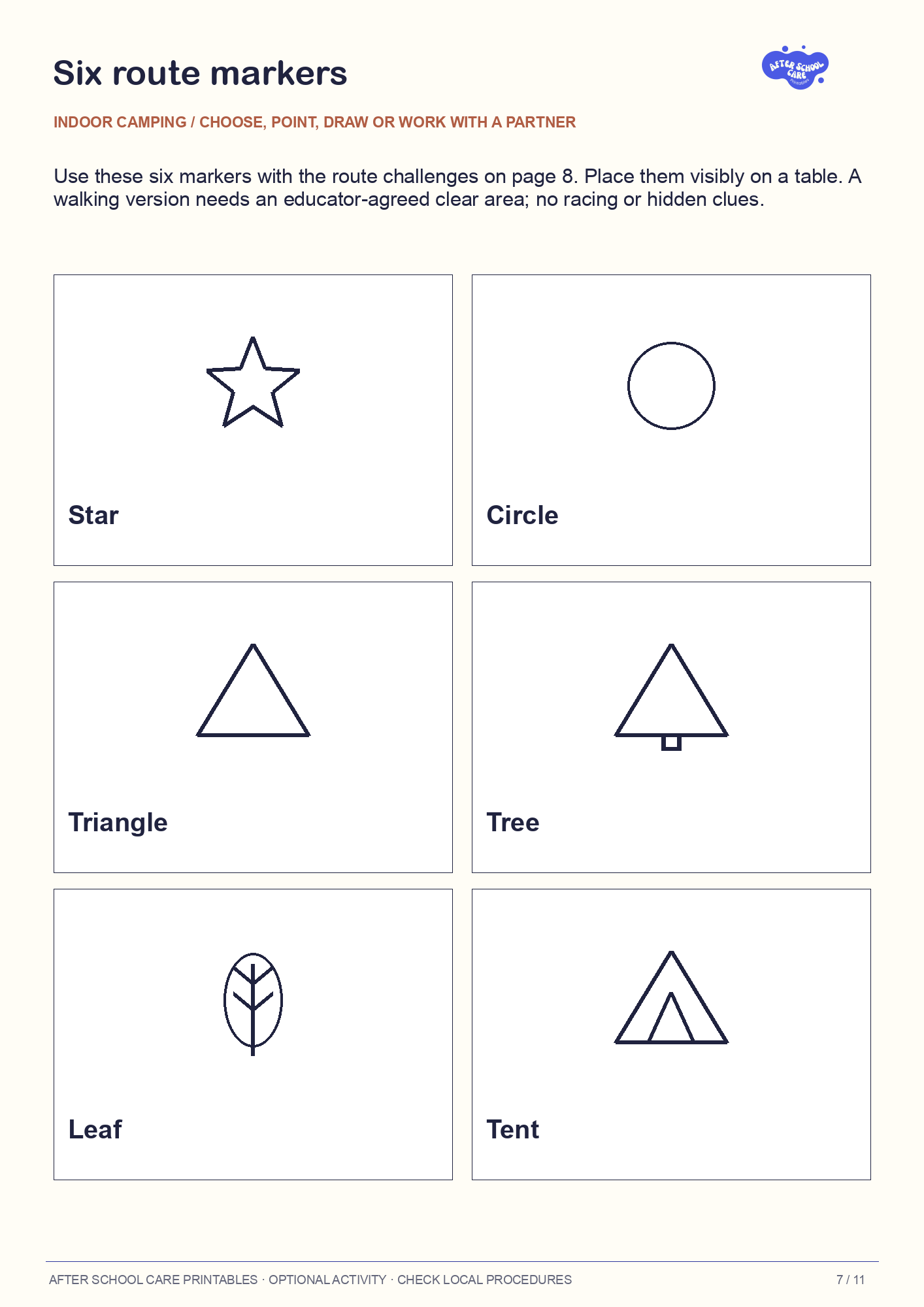
- Page 7: Six route markers
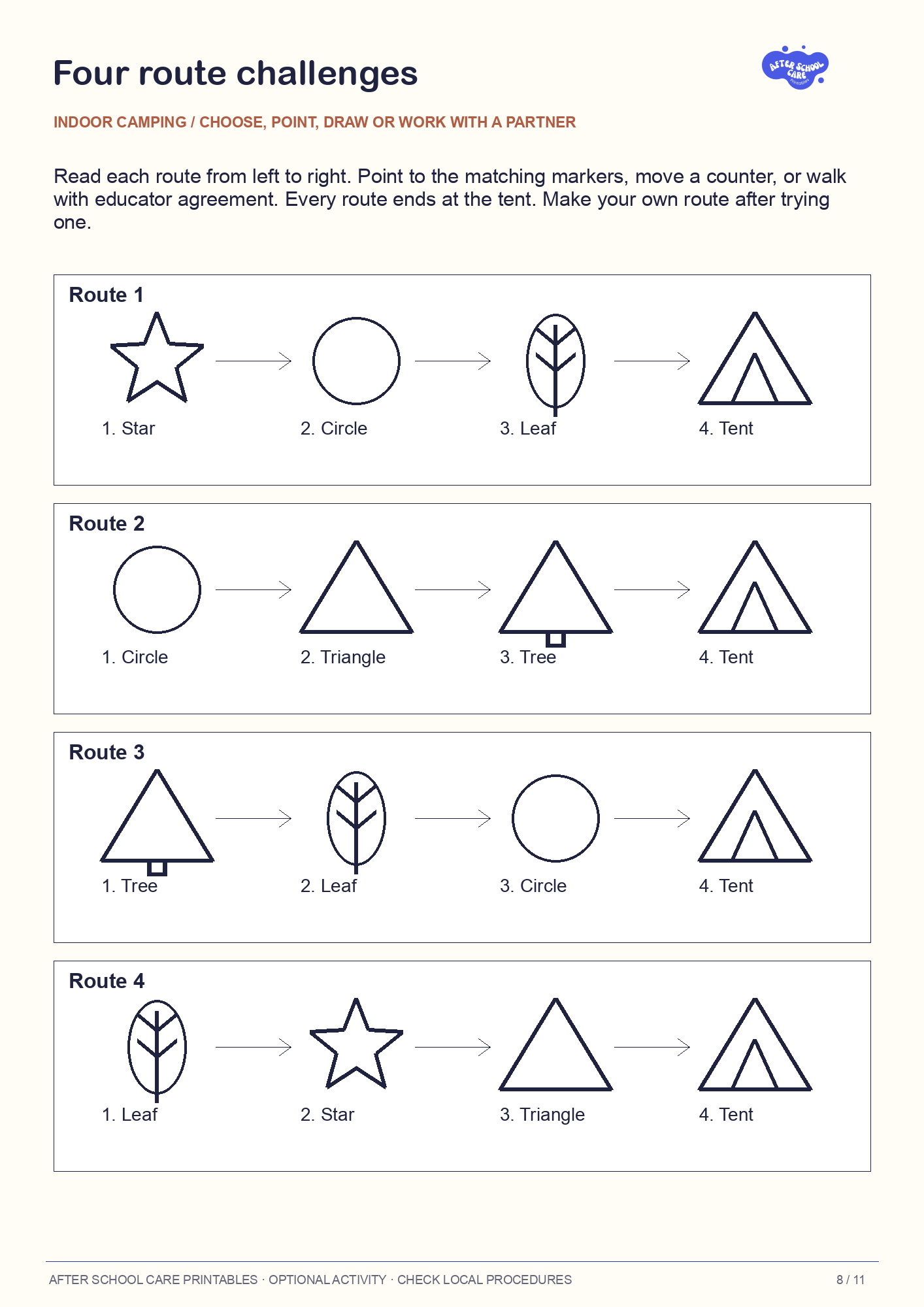
- Page 8: Four route challenges
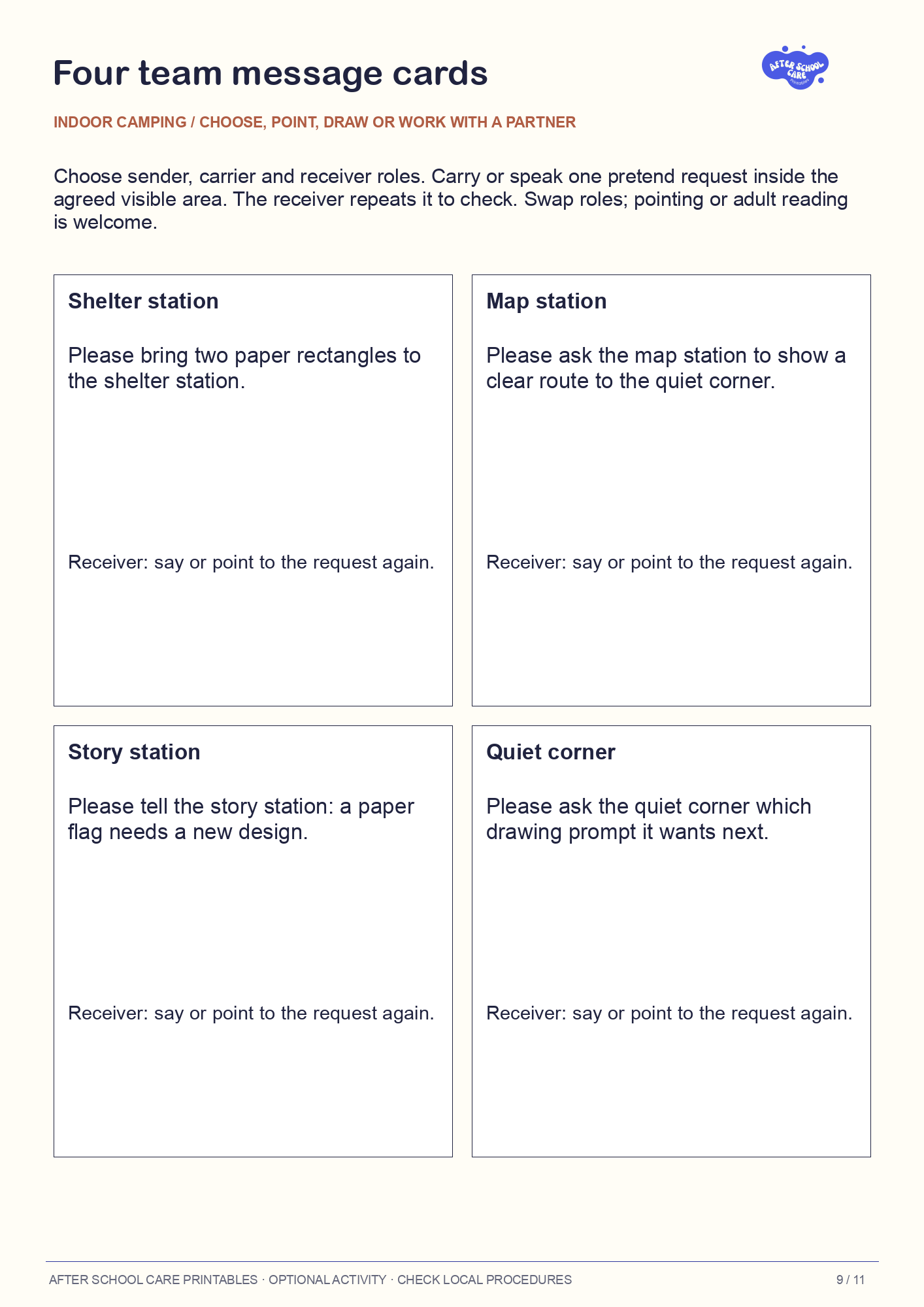
- Page 9: Four team message cards
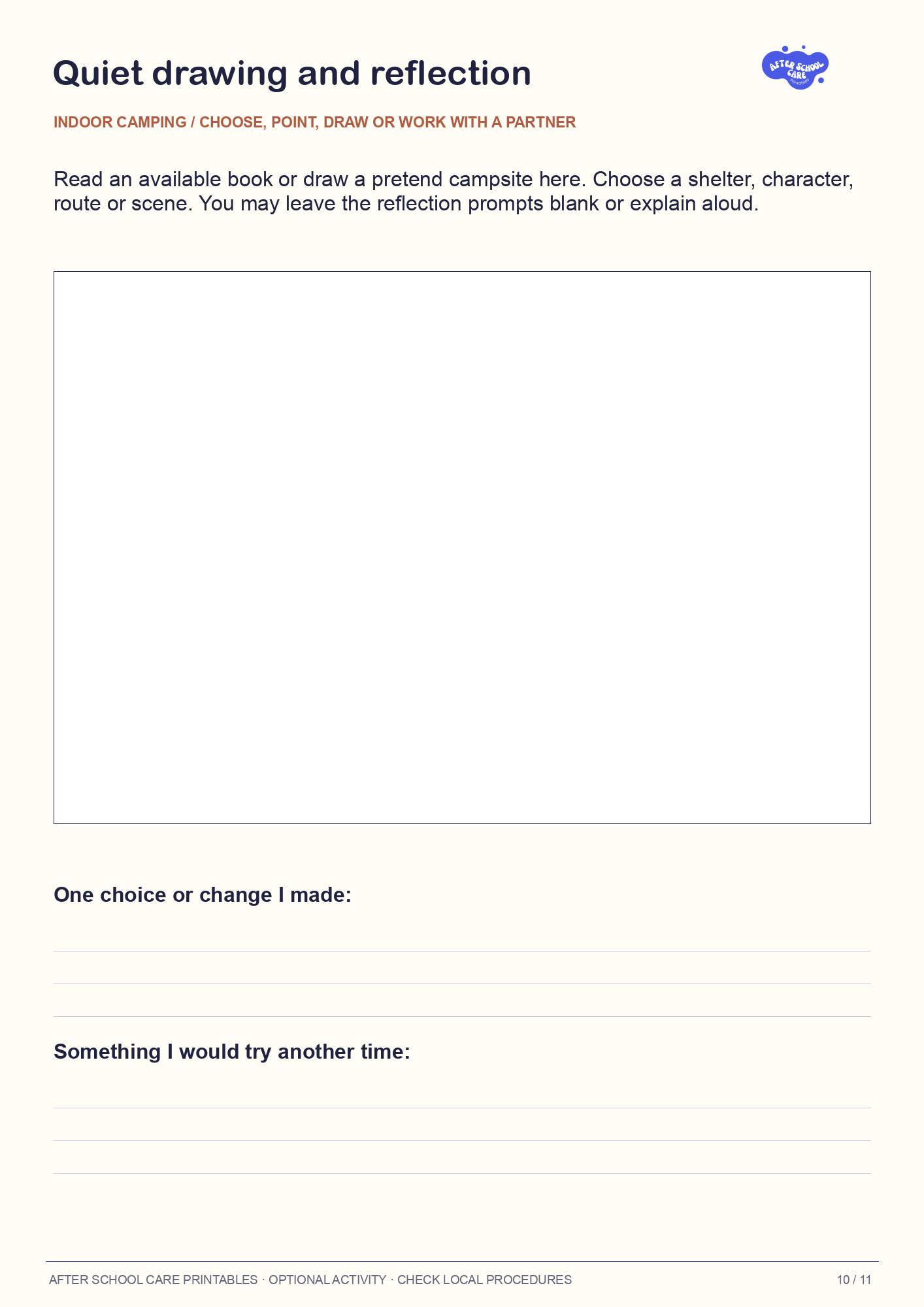
- Page 10: Quiet drawing and reflection
- Page 11: Preparation and 120-minute session
Prepare and run the activities
Allow about 20 minutes to print selected pages, cut cards if wanted and gather paper materials. Choose an open visible area and a quiet reading or drawing corner. Check the room and movement boundaries using local procedures. Make one small paper shelter to demonstrate; no child-sized fort is needed.
Route activity: Place the six page 7 markers in visible positions on a table. Read page 8 from left to right; point to each matching marker or move a counter. For a walking version, an educator chooses a clear, short route and secures cards using venue procedures. No racing, hiding or searching private areas. Every route finishes at the tent symbol.
Team messages: Agree on visible station locations. A sender chooses a page 9 card; a carrier takes or speaks it to a receiver, who repeats the request to check it. Swap roles. Pointing, an adult reader or a tabletop version are equally useful. Use pretend requests only; do not record names or private messages.
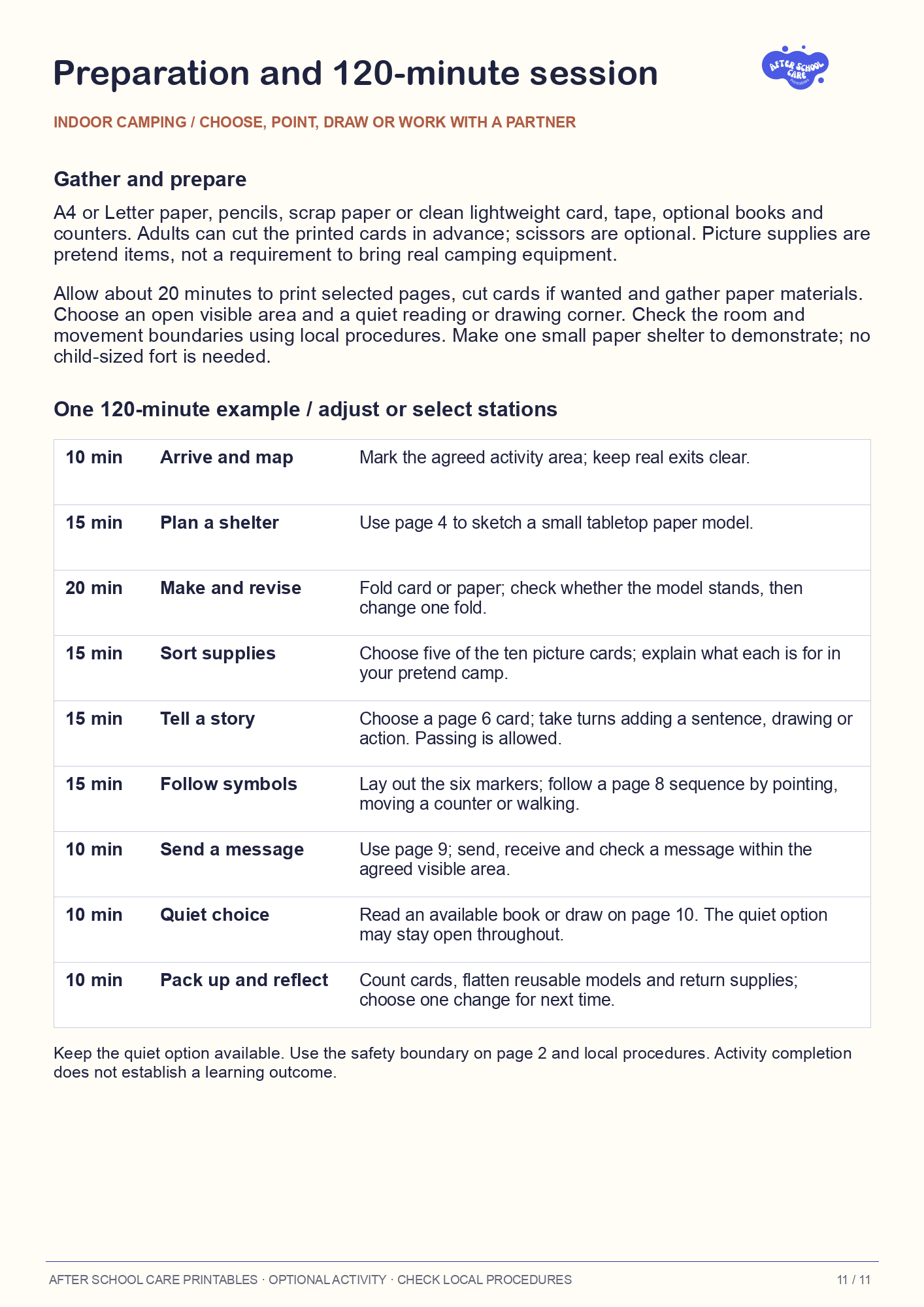
A 120-minute example
- 10 minutes · Arrive and map: Mark the agreed activity area; keep real exits clear.
- 15 minutes · Plan a shelter: Use page 4 to sketch a small tabletop paper model.
- 20 minutes · Make and revise: Fold card or paper; check whether the model stands, then change one fold.
- 15 minutes · Sort supplies: Choose five of the ten picture cards; explain what each is for in your pretend camp.
- 15 minutes · Tell a story: Choose a page 6 card; take turns adding a sentence, drawing or action. Passing is allowed.
- 15 minutes · Follow symbols: Lay out the six markers; follow a page 8 sequence by pointing, moving a counter or walking.
- 10 minutes · Send a message: Use page 9; send, receive and check a message within the agreed visible area.
- 10 minutes · Quiet choice: Read an available book or draw on page 10. The quiet option may stay open throughout.
- 10 minutes · Pack up and reflect: Count cards, flatten reusable models and return supplies; choose one change for next time.
Keep the quiet option open throughout. The times are a planning example, not an attendance requirement or staffing determination. Use your service's procedures and adapt the session to the group.
Route checking reference:
- Route 1: Star → Circle → Leaf → Tent.
- Route 2: Circle → Triangle → Tree → Tent.
- Route 3: Tree → Leaf → Circle → Tent.
- Route 4: Leaf → Star → Triangle → Tent.