Resource
Five-Minute Conversation Challenge Cards
Start a short, low-pressure conversation when a group is waiting or settling. Includes a two-page A4 printable, specific educator guidance, adaptations and a cut-off quick-reference card.
Ready for a real OSHC session
Preview both printable pages
Download 2-page practical printableCheck the preview, printing notes and licence before use.
When this resource is useful
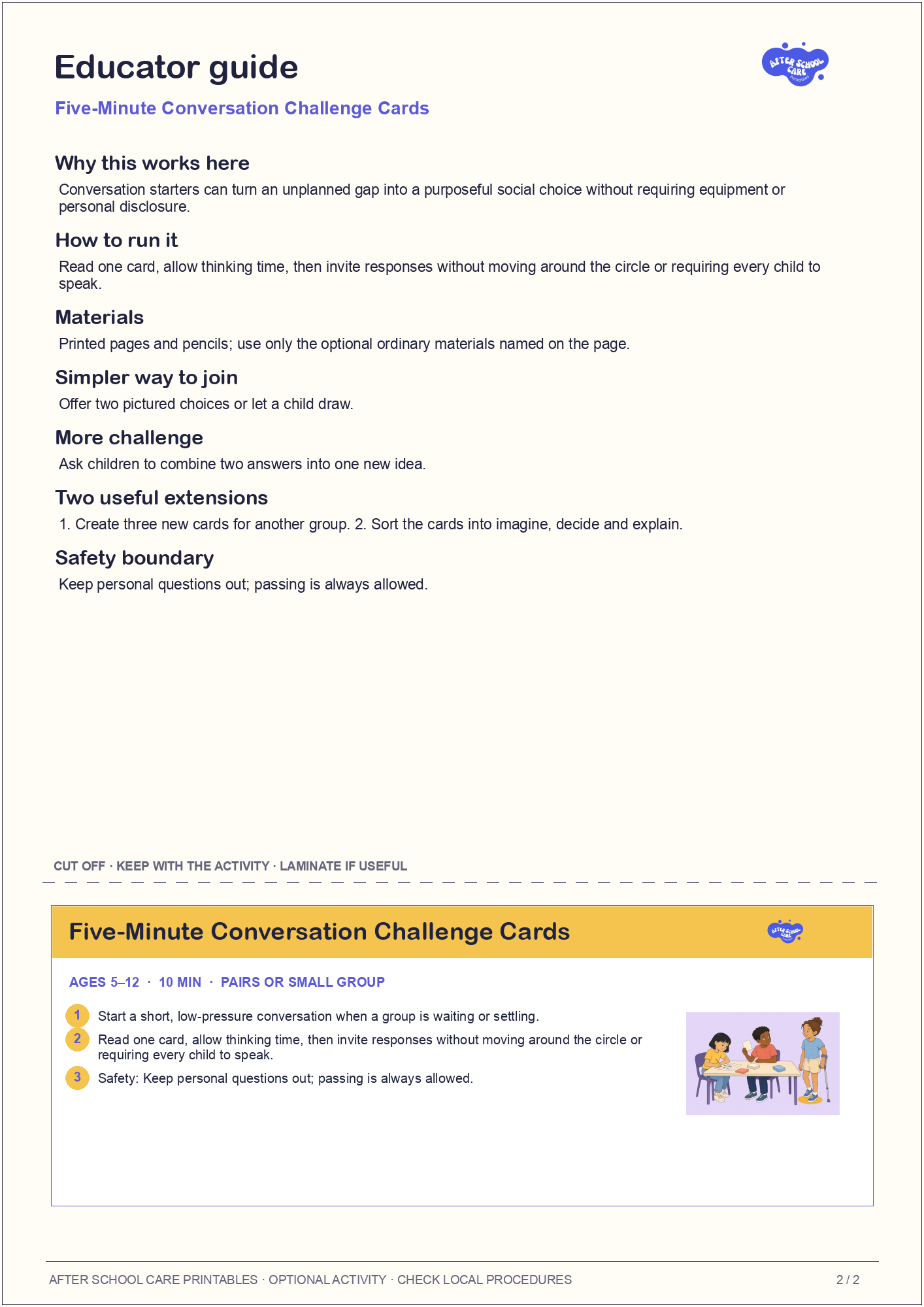
Conversation starters can turn an unplanned gap into a purposeful social choice without requiring equipment or personal disclosure.
What children do
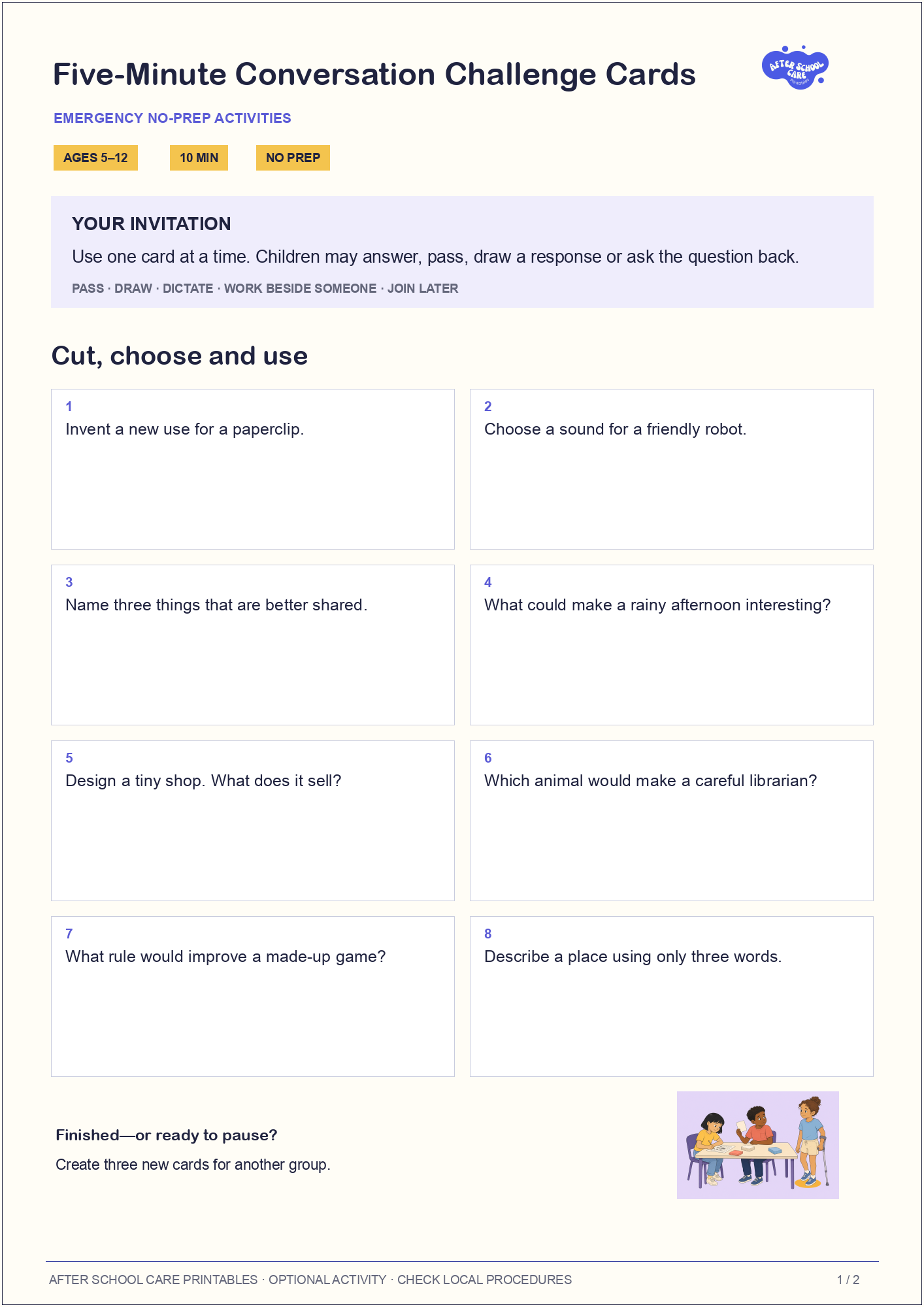
Use one card at a time. Children may answer, pass, draw a response or ask the question back.
Materials and preparation
Materials: Printed pages and pencils; use only the optional ordinary materials named on the page.
Allow about 2 minutes to print and place the resource. The activity itself usually takes 10 minutes and can pause when the group needs to transition.
Run the activity
Read one card, allow thinking time, then invite responses without moving around the circle or requiring every child to speak.
The child-facing prompts are:
- Invent a new use for a paperclip.
- Choose a sound for a friendly robot.
- Name three things that are better shared.
- What could make a rainy afternoon interesting?
- Design a tiny shop. What does it sell?
- Which animal would make a careful librarian?
- What rule would improve a made-up game?
- Describe a place using only three words.
Adapt participation
Simpler way to join: Offer two pictured choices or let a child draw.
More challenge: Ask children to combine two answers into one new idea.
Children may draw, dictate, point, work beside a peer, observe or join later. Start, Explore and Extend labels describe task routes, not children.
Extend the idea
- Create three new cards for another group.
- Sort the cards into imagine, decide and explain.
Safety and privacy
Keep personal questions out; passing is always allowed.
Learning opportunities
Look for choice, communication, creative thinking and independent engagement. Record what children choose, explain, test or revise rather than treating completion as proof of learning.
Checking an open-ended response
There is no single required answer. A useful response follows the printed condition and can be explained, demonstrated or revised by the child.
Printing notes
Print at actual size on A4 paper. Page one is child-facing. Page two contains educator guidance and a dashed cut-off reference card that can be kept with the activity or laminated.