Resource
Recycled-Material Invention Cards
Turn clean reused materials into useful prototypes for specific users and tasks. Includes a two-page A4 printable, specific educator guidance, adaptations and a cut-off quick-reference card.
Ready for a real OSHC session
Preview both printable pages
Download 2-page practical printableCheck the preview, printing notes and licence before use.
When this resource is useful
Constraint cards prevent recycled making from becoming an unplanned pile of materials and keep usefulness central.
What children do
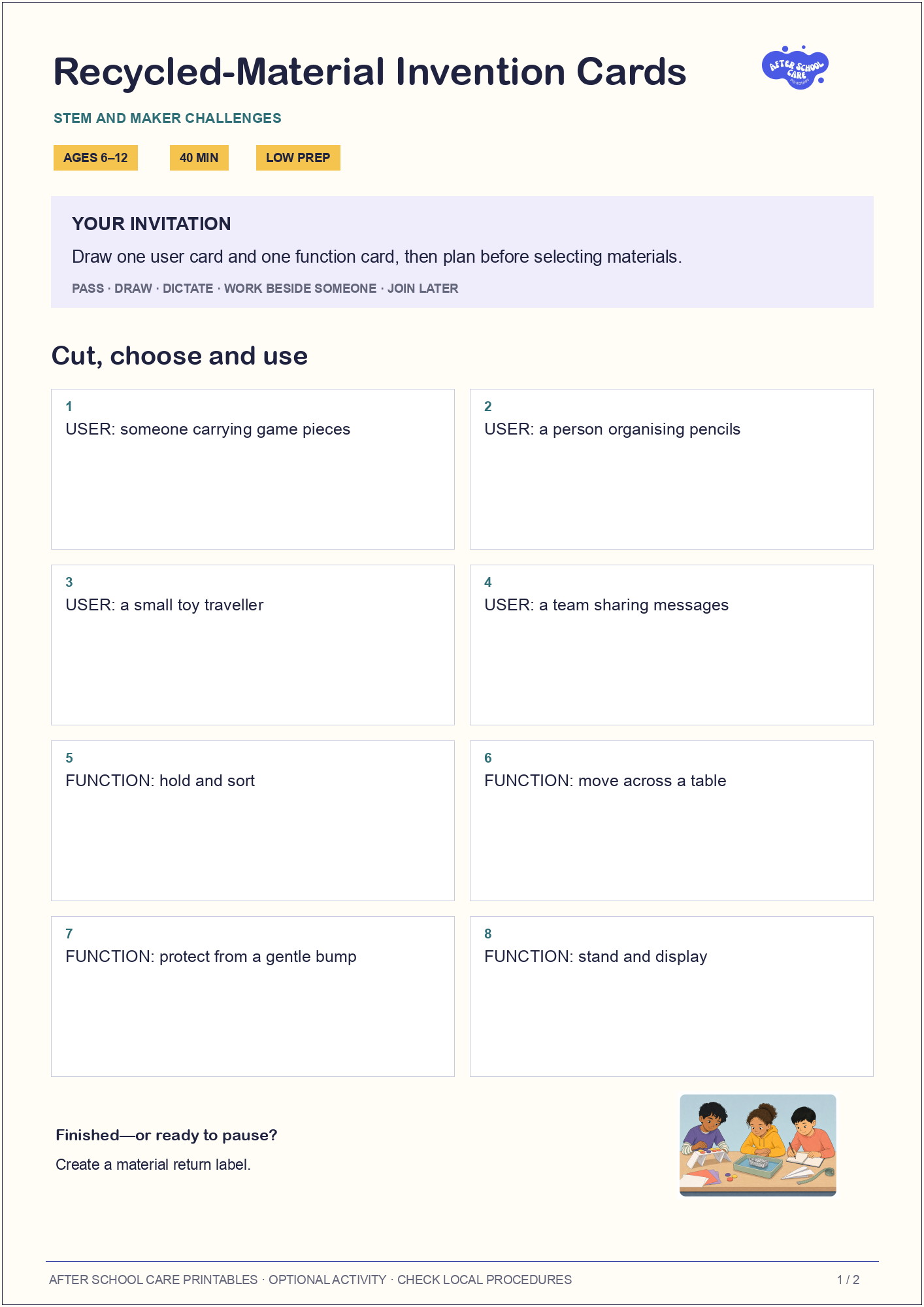
Draw one user card and one function card, then plan before selecting materials.
Materials and preparation
Materials: Printed guide, pencils and the ordinary challenge materials listed on the page.
Allow about 10 minutes to print and place the resource. The activity itself usually takes 40 minutes and can pause when the group needs to transition.
Run the activity
Set out a small clean selection. Children sketch, choose only needed pieces, build and ask another person to test.
The child-facing prompts are:
- USER: someone carrying game pieces
- USER: a person organising pencils
- USER: a small toy traveller
- USER: a team sharing messages
- FUNCTION: hold and sort
- FUNCTION: move across a table
- FUNCTION: protect from a gentle bump
- FUNCTION: stand and display
Adapt participation
Simpler way to join: Choose one box and one joining method.
More challenge: Use no tape or design for disassembly and reuse.
Children may draw, dictate, point, work beside a peer, observe or join later.
Extend the idea
- Create a material return label.
- Compare the waste from two joining methods.
Safety and privacy
Use only clean, dry, non-food packaging and service-approved tools; exclude sharp, contaminated or allergy-risk materials.
Learning opportunities
Look for planning, testing, evidence, measurement and design revision. Record what children choose, explain, test or revise rather than treating completion as proof of learning.
Checking an open-ended response
There is no single required answer. A useful response follows the printed condition and can be explained, demonstrated or revised by the child.
Printing notes
Print at actual size on A4 paper. Page one is child-facing. Page two contains educator guidance and a dashed cut-off reference card that can be kept with the activity or laminated.