Resource
Odd-One-Out Visual Reasoning Sheets
Identify which symbol differs and explain more than one possible rule. Includes a two-page A4 printable, specific educator guidance, adaptations and a cut-off quick-reference card.
Ready for a real OSHC session
Preview both printable pages
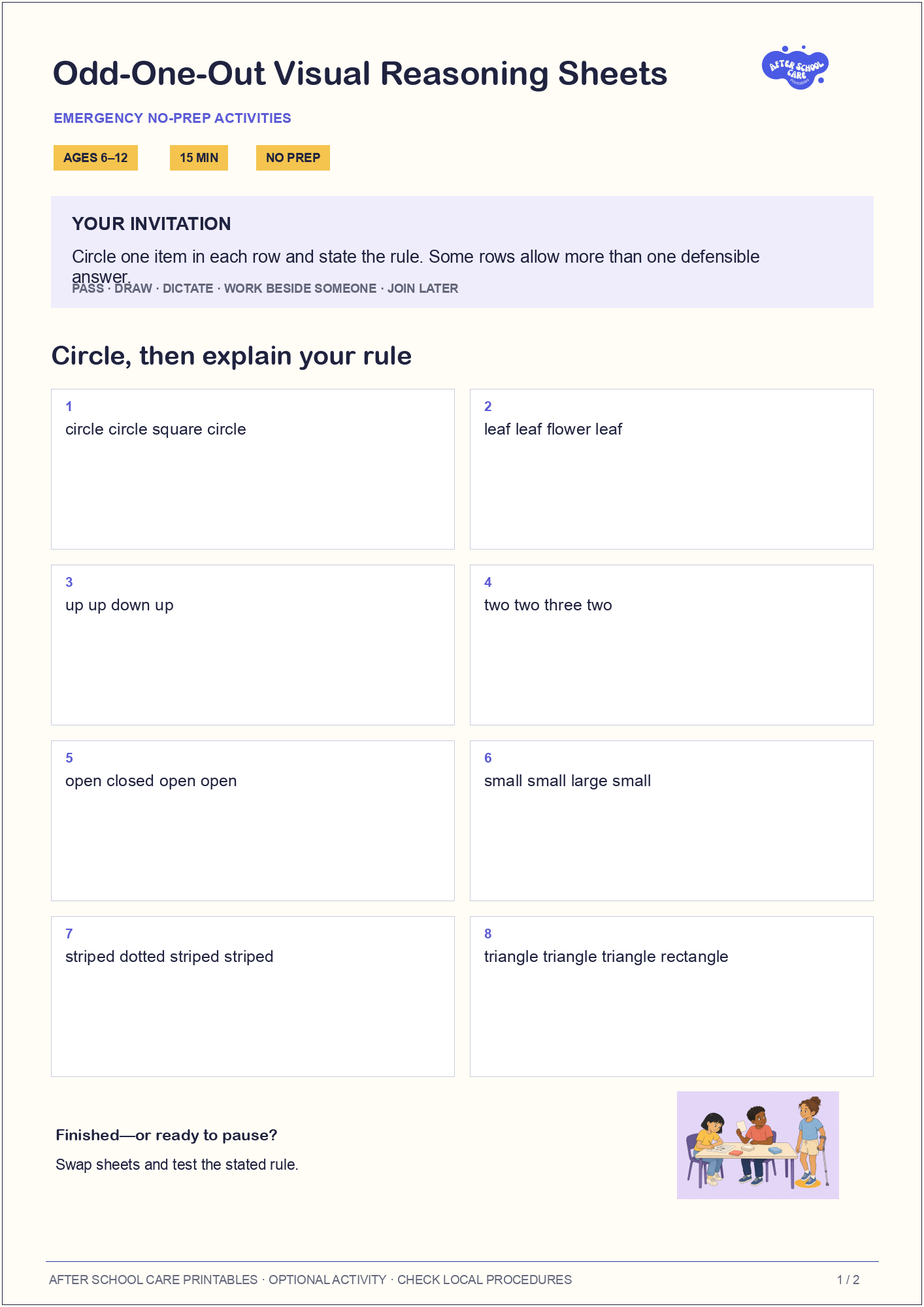
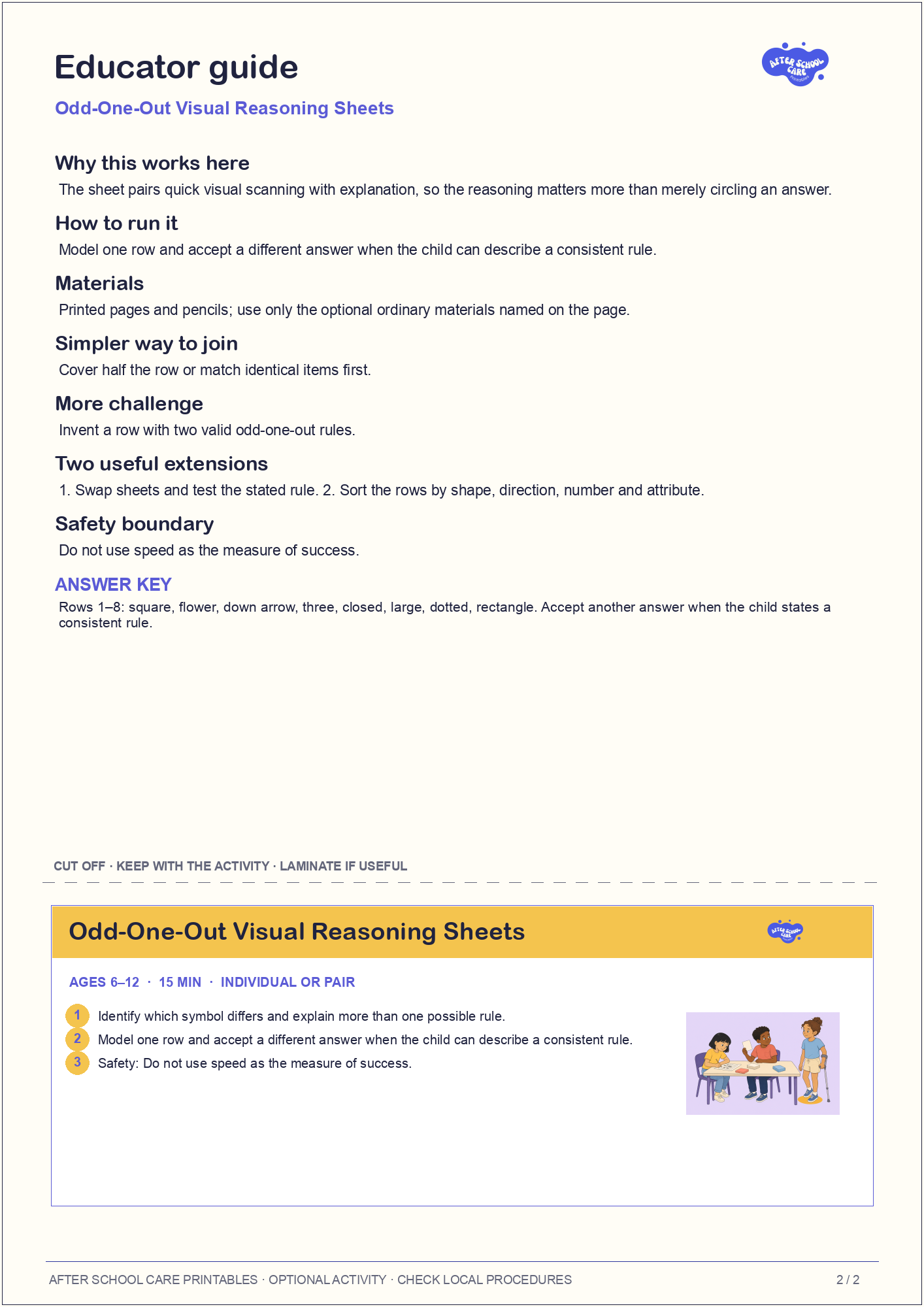
Download 2-page practical printableCheck the preview, printing notes and licence before use.
When this resource is useful
The sheet pairs quick visual scanning with explanation, so the reasoning matters more than merely circling an answer.
What children do
Circle one item in each row and state the rule. Some rows allow more than one defensible answer.
Materials and preparation
Materials: Printed pages and pencils; use only the optional ordinary materials named on the page.
Allow about 2 minutes to print and place the resource. The activity itself usually takes 15 minutes and can pause when the group needs to transition.
Run the activity
Model one row and accept a different answer when the child can describe a consistent rule.
The child-facing prompts are:
- circle circle square circle
- leaf leaf flower leaf
- up up down up
- two two three two
- open closed open open
- small small large small
- striped dotted striped striped
- triangle triangle triangle rectangle
Adapt participation
Simpler way to join: Cover half the row or match identical items first.
More challenge: Invent a row with two valid odd-one-out rules.
Children may draw, dictate, point, work beside a peer, observe or join later. Start, Explore and Extend labels describe task routes, not children.
Extend the idea
- Swap sheets and test the stated rule.
- Sort the rows by shape, direction, number and attribute.
Safety and privacy
Do not use speed as the measure of success.
Learning opportunities
Look for choice, communication, creative thinking and independent engagement. Record what children choose, explain, test or revise rather than treating completion as proof of learning.
Answer key
Rows 1–8: square, flower, down arrow, three, closed, large, dotted, rectangle. Accept another answer when the child states a consistent rule.
Printing notes
Print at actual size on A4 paper. Page one is child-facing. Page two contains educator guidance and a dashed cut-off reference card that can be kept with the activity or laminated.