Resource
News Analysis Worksheet for Kids – 5 W’s + How Printable
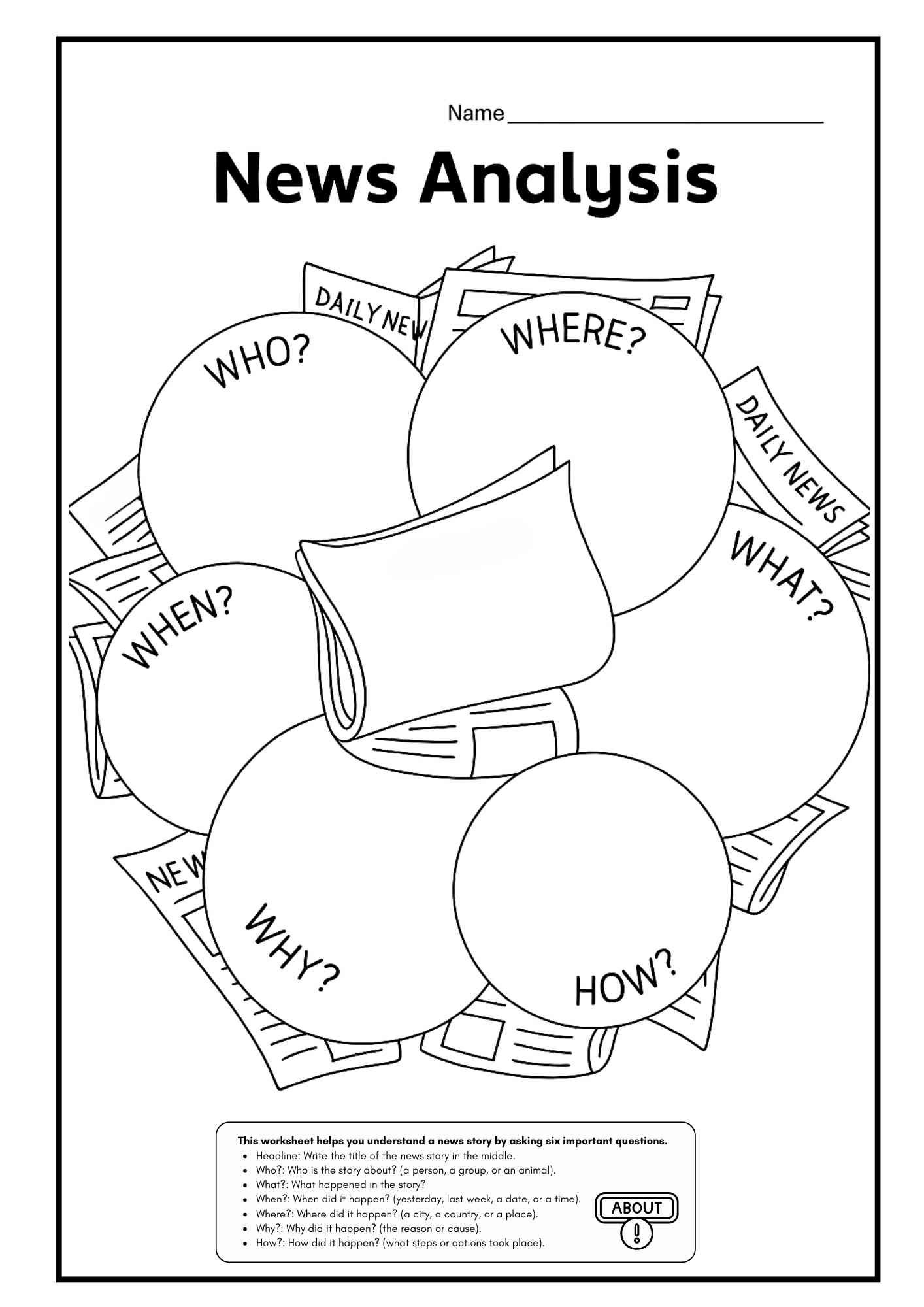
Read a short news story together, add its headline in the centre and record what the story says about who, what, when, where, why and how.
Download printableCheck the preview, printing notes and licence before use.
Read one story closely
This one-page worksheet has six overlapping question spaces around a central headline panel. Children read or listen to a selected news story, then use the spaces to record what that story actually tells them. It is a reading and discussion activity, not a check that a news report is true.
Allow about 20–30 minutes with a short article. Ages 8–12 are a starting guide; choose the text by reading confidence and the support available. The small spaces suit keywords or short phrases rather than a full paragraph.
Prepare the story and materials
Select a short, age-appropriate report and read it before the session. A local garden opening, a library event or an animal rescue can provide concrete details without requiring distressing news. Check the topic against your group's needs. Provide the worksheet, pencils, erasers and a copy of the article or a way to read it aloud. No cutting or colouring is required.
Keep the article's title, publisher and publication date available. Children can add these on the back or on separate paper because the worksheet has no dedicated source box. The name line is optional; the discussion does not require personal information or a record of children's opinions.
Use the six question spaces
- Read the story together. Put its headline in the central newspaper shape; shorten it if necessary and keep the full headline with the article.
- Start with who, what, when and where. Find a sentence that supports each answer. The date of publication may differ from the date the event happened.
- Try why and how. Record the reason or sequence the report gives. If it does not say, write “not stated” or leave a question to investigate; do not invent a cause to fill the space.
- Compare answers with a partner. Ask “Where does the story tell us that?” If someone is quoted, make clear whose account or opinion it is.
- Ask what is still missing. Keep an unanswered question on separate paper rather than squeezing it into a crowded circle.
Completing all six spaces does not verify a story. An optional extension is to compare another report of the same event: identify an added detail, a different description or an unanswered question without assuming that agreement proves accuracy.
Adjust participation
Read the article aloud, work on two question spaces first or let a child point to a supporting sentence while a partner writes keywords. Offer blank paper for larger writing or drawings with labels. Children may discuss an invented report if the real topic is uncomfortable; label that report as fictional.
For a more demanding task, separate a reported observation from a quoted opinion and explain what further information would help. Avoid asking children to disclose experiences similar to the news story.
Print and finish
The supplied PDF is A4 and works in greyscale. Preview before printing; fit to the printable area if a border would be clipped. A Letter printer can scale the A4 page, but check that the small instructions remain readable. Use a larger copy or separate paper when more writing space is needed.
Invite children to share one supported answer or one unanswered question. Return the pencils and keep the source article with any worksheet you retain.