Resource
Mini Carnival Station Cards
Run simple reusable carnival stations with shared goals and no public ranking. Includes a two-page A4 printable, specific educator guidance, adaptations and a cut-off quick-reference card.
Ready for a real OSHC session
Preview both printable pages
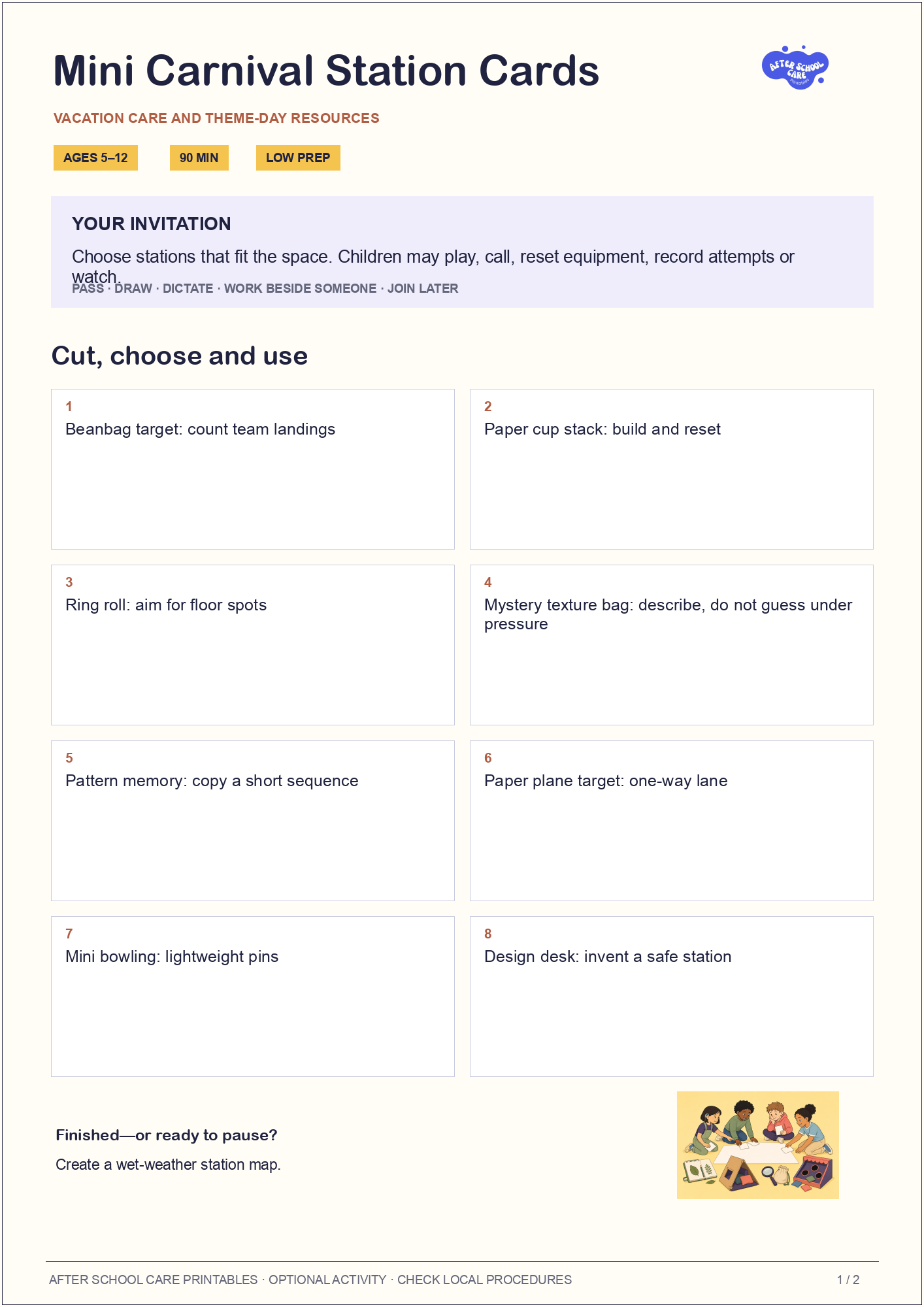
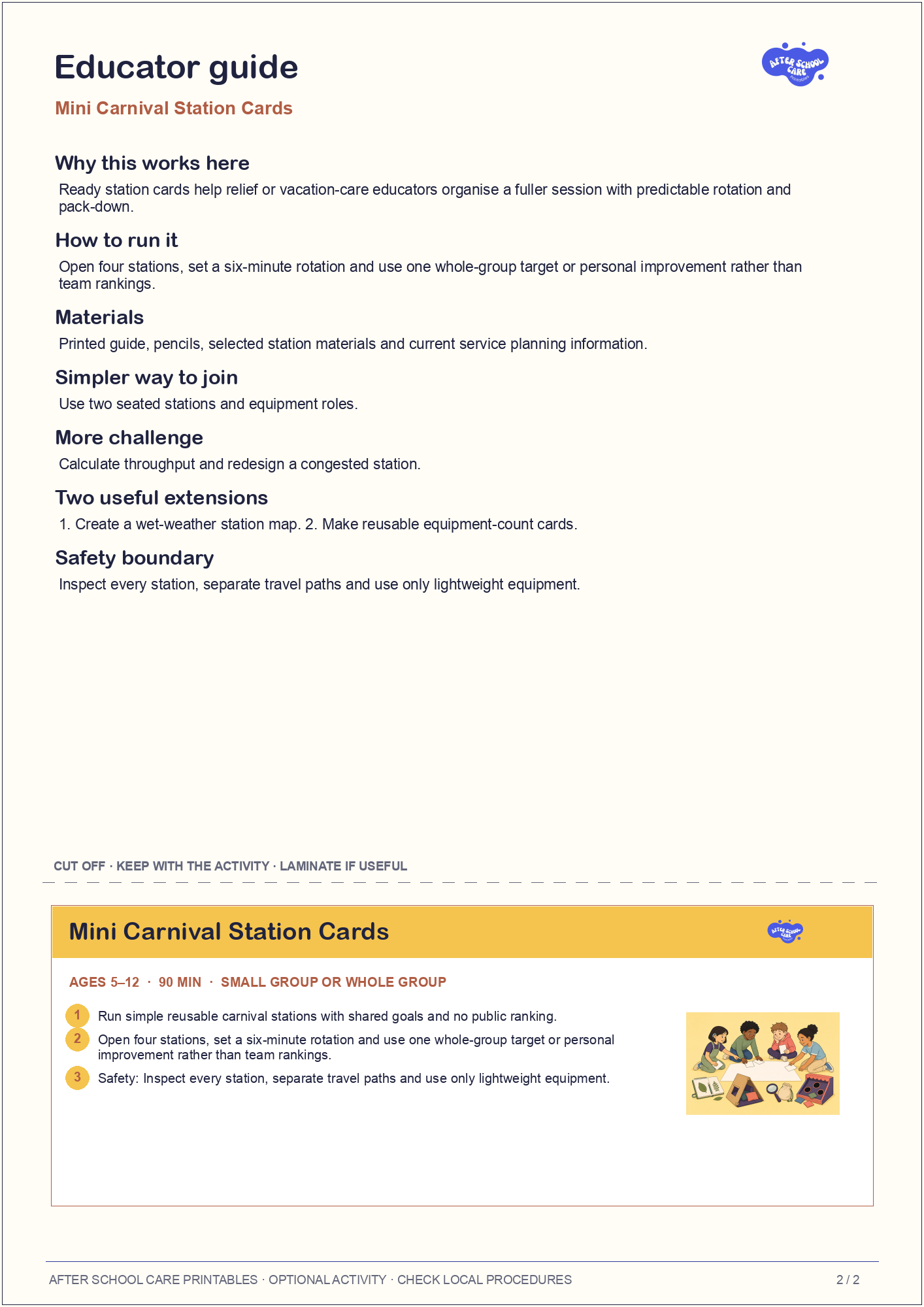
Download 2-page practical printableCheck the preview, printing notes and licence before use.
When this resource is useful
Ready station cards help relief or vacation-care educators organise a fuller session with predictable rotation and pack-down.
What children do
Choose stations that fit the space. Children may play, call, reset equipment, record attempts or watch.
Materials and preparation
Materials: Printed guide, pencils, selected station materials and current service planning information.
Allow about 10 minutes to print and place the resource. The activity itself usually takes 90 minutes and can pause when the group needs to transition.
Run the activity
Open four stations, set a six-minute rotation and use one whole-group target or personal improvement rather than team rankings.
The child-facing prompts are:
- Beanbag target: count team landings
- Paper cup stack: build and reset
- Ring roll: aim for floor spots
- Mystery texture bag: describe, do not guess under pressure
- Pattern memory: copy a short sequence
- Paper plane target: one-way lane
- Mini bowling: lightweight pins
- Design desk: invent a safe station
Adapt participation
Simpler way to join: Use two seated stations and equipment roles.
More challenge: Calculate throughput and redesign a congested station.
Children may draw, dictate, point, work beside a peer, observe or join later. Start, Explore and Extend labels describe task routes, not children.
Extend the idea
- Create a wet-weather station map.
- Make reusable equipment-count cards.
Safety and privacy
Inspect every station, separate travel paths and use only lightweight equipment.
Learning opportunities
Look for program participation, planning, collaboration and reflection. Record what children choose, explain, test or revise rather than treating completion as proof of learning.
Checking an open-ended response
There is no single required answer. A useful response follows the printed condition and can be explained, demonstrated or revised by the child.
Printing notes
Print at actual size on A4 paper. Page one is child-facing. Page two contains educator guidance and a dashed cut-off reference card that can be kept with the activity or laminated.