Resource
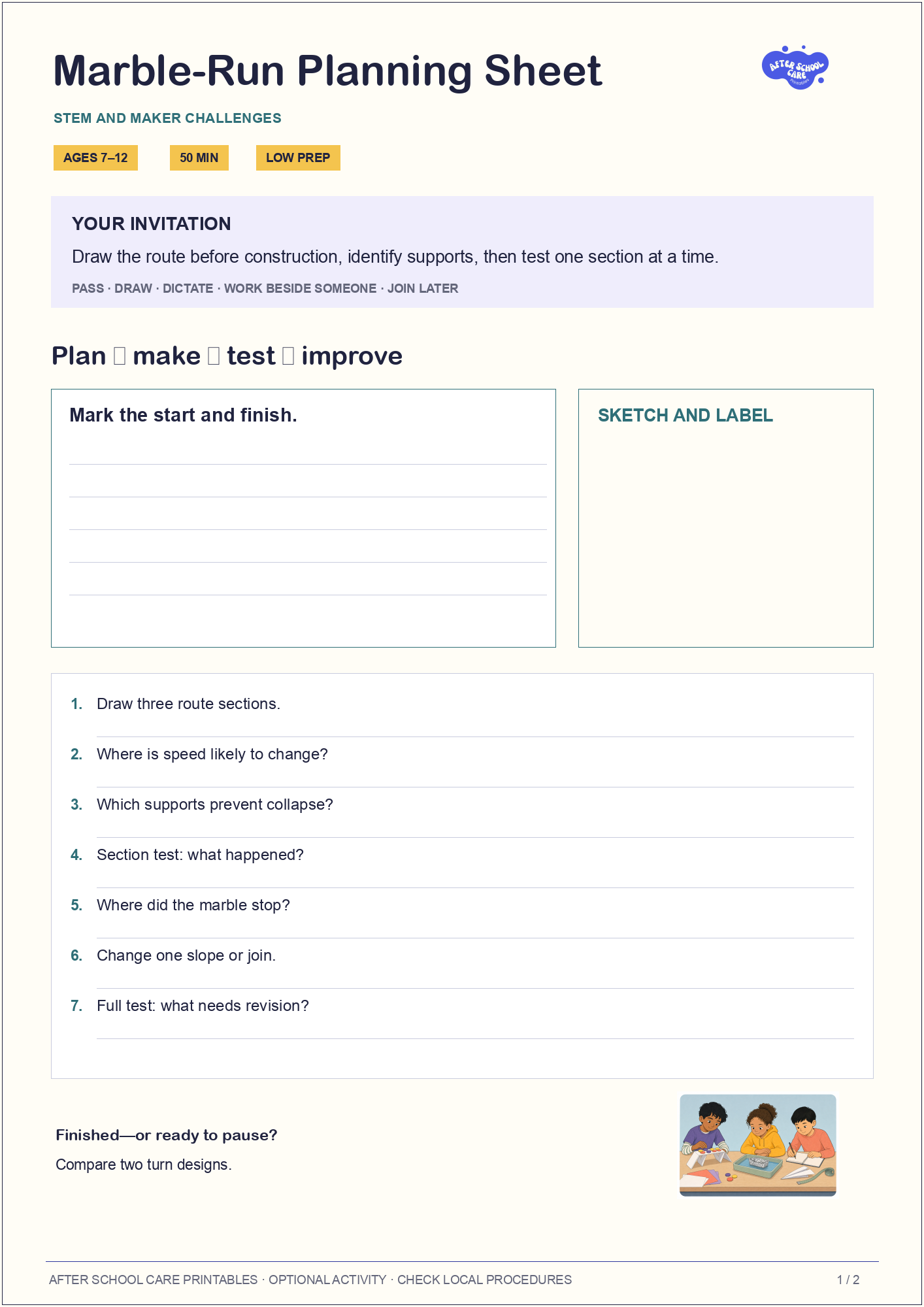
Marble-Run Planning Sheet
Plan a contained marble run with a start, finish, turns and a safely observable test. Includes a two-page A4 printable, specific educator guidance, adaptations and a cut-off quick-reference card.
Ready for a real OSHC session
Preview both printable pages
Download 2-page practical printableCheck the preview, printing notes and licence before use.
When this resource is useful
Planning first reduces material waste and helps groups reason about slope, connection and support.
What children do
Draw the route before construction, identify supports, then test one section at a time.
Materials and preparation
Materials: Printed guide, pencils and the ordinary challenge materials listed on the page.
Allow about 10 minutes to print and place the resource. The activity itself usually takes 50 minutes and can pause when the group needs to transition.
Run the activity
Use cardboard channels over a table or floor tray. Test low sections before joining the full route.
The child-facing prompts are:
- Mark the start and finish.
- Draw three route sections.
- Where is speed likely to change?
- Which supports prevent collapse?
- Section test: what happened?
- Where did the marble stop?
- Change one slope or join.
- Full test: what needs revision?
Adapt participation
Simpler way to join: Use a rolling ball too large to swallow and a ready-made short channel.
More challenge: Add a target travel time without increasing height.
Children may draw, dictate, point, work beside a peer, observe or join later. Start, Explore and Extend labels describe task routes, not children.
Extend the idea
- Compare two turn designs.
- Create a labelled troubleshooting card.
Safety and privacy
Use age-appropriate rolling objects, contain the route, avoid head height and count every marble after use.
Learning opportunities
Look for planning, testing, evidence, measurement and design revision. Record what children choose, explain, test or revise rather than treating completion as proof of learning.
Checking an open-ended response
There is no single required answer. A useful response follows the printed condition and can be explained, demonstrated or revised by the child.
Printing notes
Print at actual size on A4 paper. Page one is child-facing. Page two contains educator guidance and a dashed cut-off reference card that can be kept with the activity or laminated.