Resource
Indoor Look-and-Find Scavenger Hunt
Search a supervised indoor area by noticing rather than collecting. Includes a two-page A4 printable, specific educator guidance, adaptations and a cut-off quick-reference card.
Ready for a real OSHC session
Preview both printable pages
Download 2-page practical printableCheck the preview, printing notes and licence before use.
When this resource is useful
A find-and-mark hunt gives mixed-age groups movement and observation without hiding objects or creating a race.
What children do
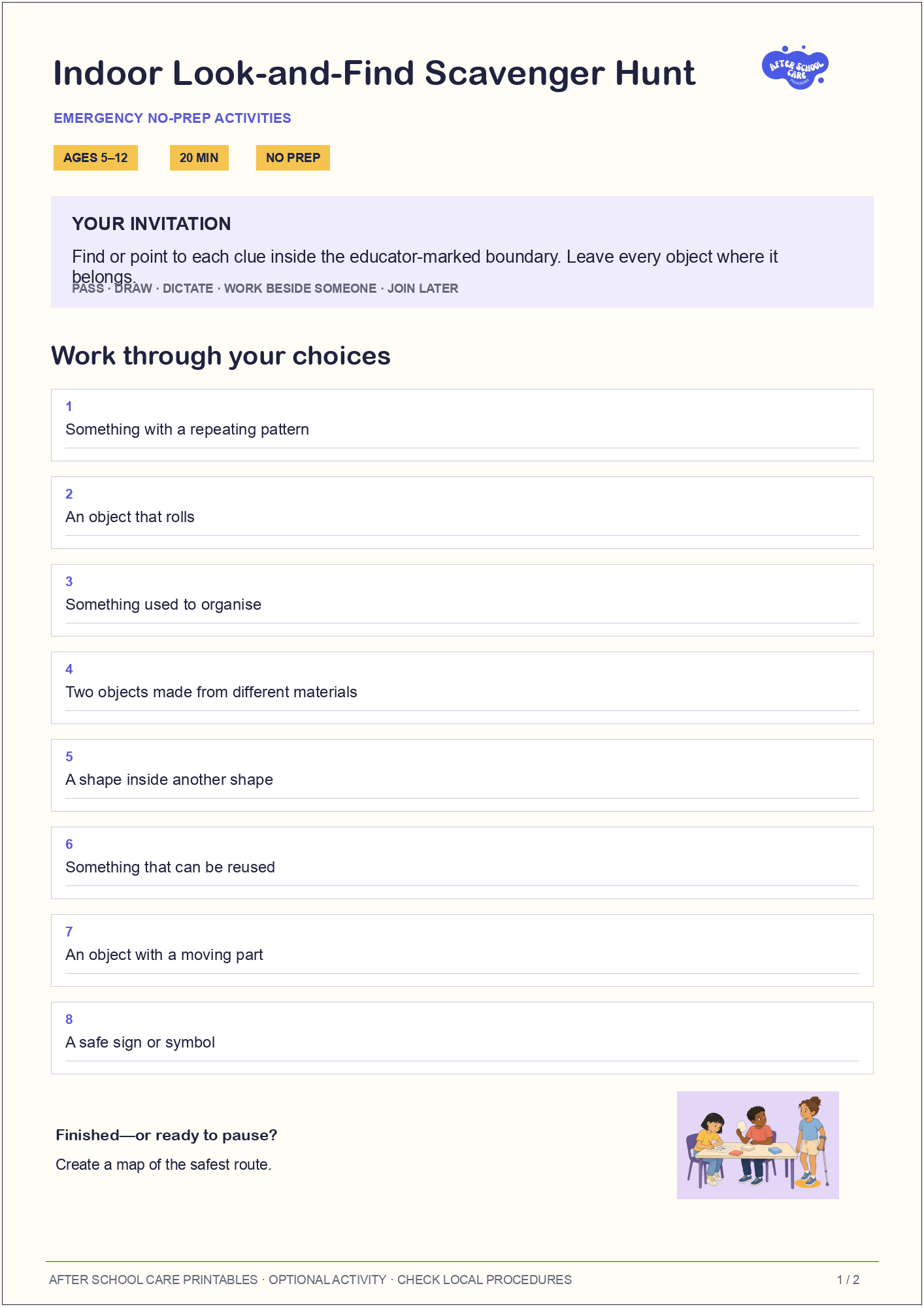
Find or point to each clue inside the educator-marked boundary. Leave every object where it belongs.
Materials and preparation
Materials: Printed pages and pencils; use only the optional ordinary materials named on the page.
Allow about 2 minutes to print and place the resource. The activity itself usually takes 20 minutes and can pause when the group needs to transition.
Run the activity
Define the exact rooms and return point. Pairs mark, draw or describe each find and return after fifteen minutes.
The child-facing prompts are:
- Something with a repeating pattern
- An object that rolls
- Something used to organise
- Two objects made from different materials
- A shape inside another shape
- Something that can be reused
- An object with a moving part
- A safe sign or symbol
Adapt participation
Simpler way to join: Use picture clues in one room.
More challenge: Add a reason or material label for every find.
Children may draw, dictate, point, work beside a peer, observe or join later.
Extend the idea
- Create a map of the safest route.
- Write four clues that do not reveal the object.
Safety and privacy
Exclude kitchens, bathrooms, storage, exits and private areas; maintain line of sight.
Learning opportunities
Look for choice, communication, creative thinking and independent engagement. Record what children choose, explain, test or revise rather than treating completion as proof of learning.
Checking an open-ended response
There is no single required answer. A useful response follows the printed condition and can be explained, demonstrated or revised by the child.
Printing notes
Print at actual size on A4 paper. Page one is child-facing. Page two contains educator guidance and a dashed cut-off reference card that can be kept with the activity or laminated.