Resource
Find Someone Who: Shared Interests
Discover optional shared interests without collecting names or ranking popularity. Includes a two-page A4 printable, specific educator guidance, adaptations and a cut-off quick-reference card.
Ready for a real OSHC session
Preview both printable pages
Download 2-page practical printableCheck the preview, printing notes and licence before use.
When this resource is useful
The activity creates low-pressure conversation while avoiding personal data, popularity comparisons and compulsory disclosure.
What children do
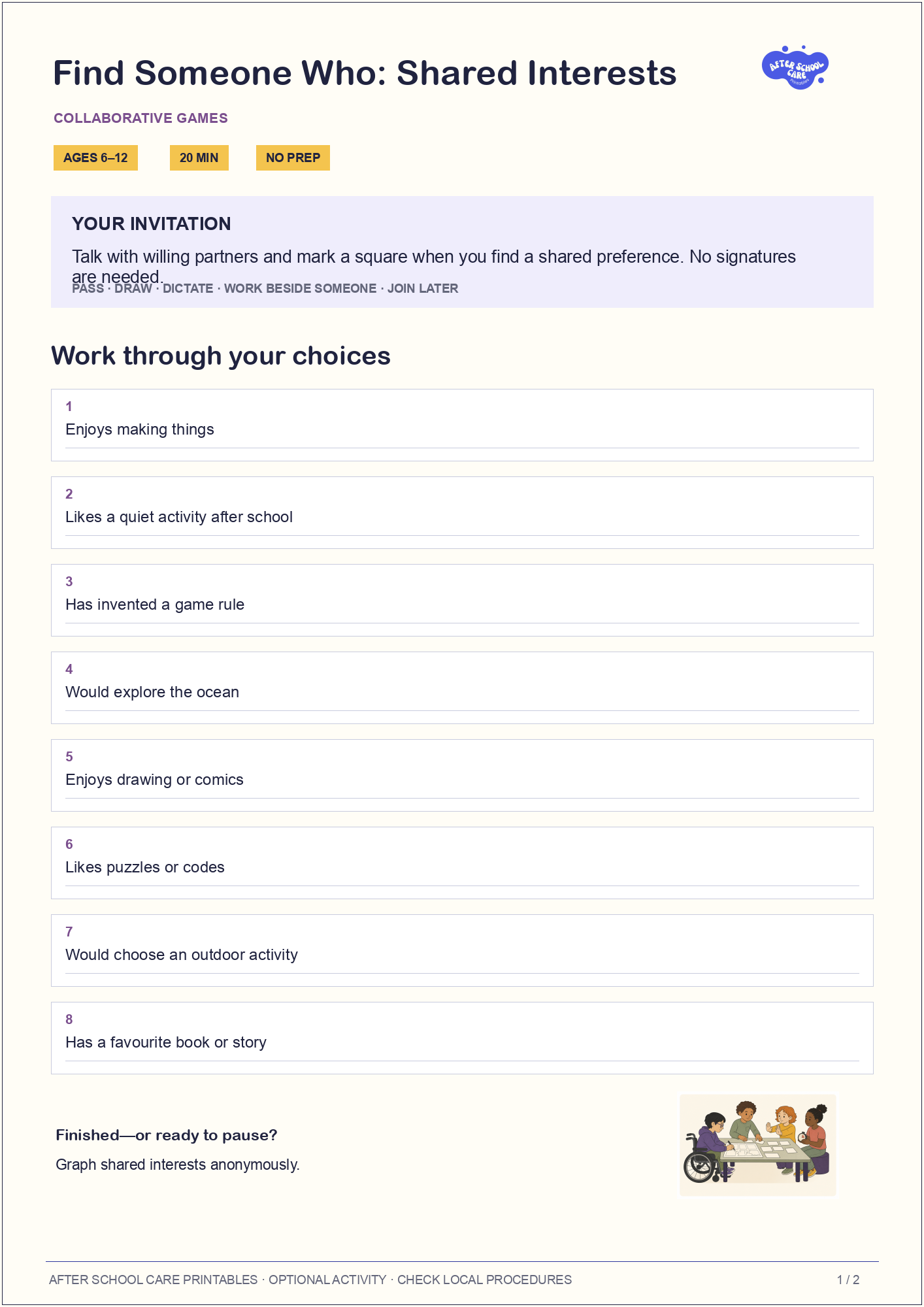
Talk with willing partners and mark a square when you find a shared preference. No signatures are needed.
Materials and preparation
Materials: Printed pages and pencils; use only the optional ordinary materials named on the page.
Allow about 2 minutes to print and place the resource. The activity itself usually takes 20 minutes and can pause when the group needs to transition.
Run the activity
Model how to ask and accept “pass”. Change partners naturally; stop after ten minutes and discuss common interests without naming people.
The child-facing prompts are:
- Enjoys making things
- Likes a quiet activity after school
- Has invented a game rule
- Would explore the ocean
- Enjoys drawing or comics
- Likes puzzles or codes
- Would choose an outdoor activity
- Has a favourite book or story
Adapt participation
Simpler way to join: Use picture cards with one known partner.
More challenge: Create a group activity menu from the interests found.
Children may draw, dictate, point, work beside a peer, observe or join later.
Extend the idea
- Graph shared interests anonymously.
- Add an interest that is missing from the sheet.
Safety and privacy
Do not ask about homes, bodies, beliefs, diagnoses or private family information.
Learning opportunities
Look for collaboration, communication, fair participation and shared problem-solving. Record what children choose, explain, test or revise rather than treating completion as proof of learning.
Checking an open-ended response
There is no single required answer. A useful response follows the printed condition and can be explained, demonstrated or revised by the child.
Printing notes
Print at actual size on A4 paper. Page one is child-facing. Page two contains educator guidance and a dashed cut-off reference card that can be kept with the activity or laminated.