Resource
Energy-Level Choice Board
Match the kind of activity wanted now with choices actually available in the service. Includes a two-page A4 printable, specific educator guidance, adaptations and a cut-off quick-reference card.
Ready for a real OSHC session
Preview both printable pages
Download 2-page practical printableCheck the preview, printing notes and licence before use.
When this resource is useful
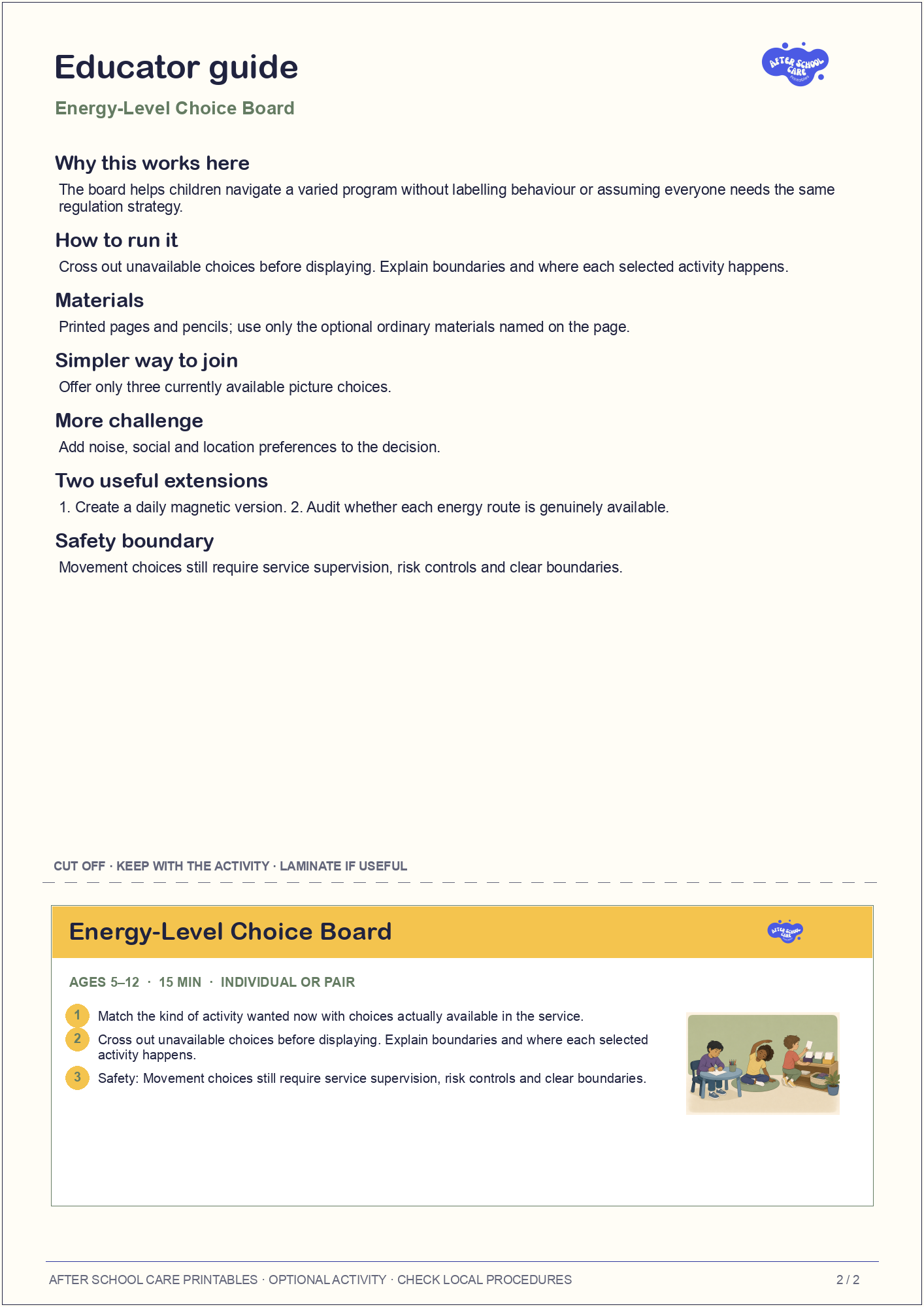
The board helps children navigate a varied program without labelling behaviour or assuming everyone needs the same regulation strategy.
What children do
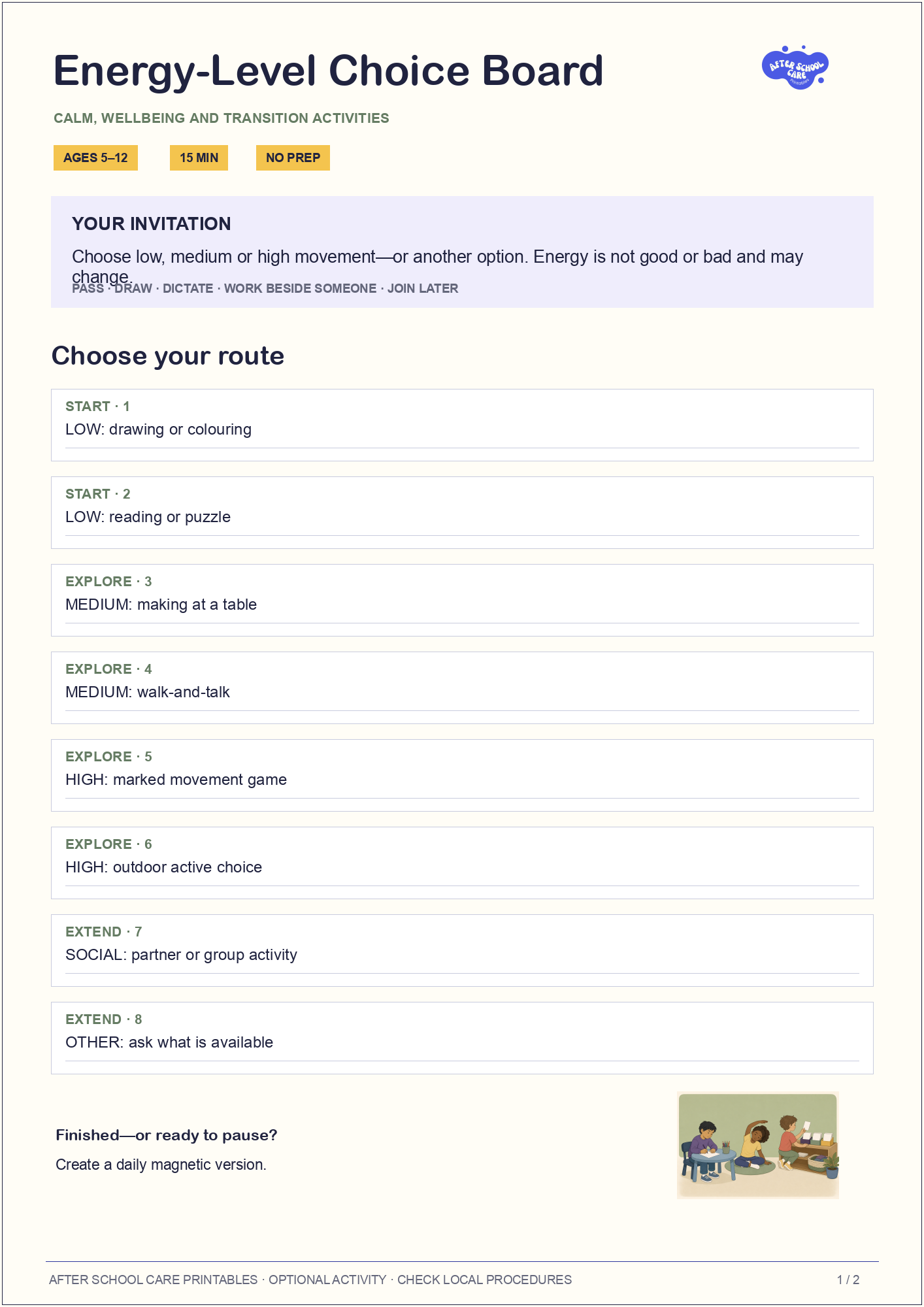
Choose low, medium or high movement—or another option. Energy is not good or bad and may change.
Materials and preparation
Materials: Printed pages and pencils; use only the optional ordinary materials named on the page.
Allow about 2 minutes to print and place the resource. The activity itself usually takes 15 minutes and can pause when the group needs to transition.
Run the activity
Cross out unavailable choices before displaying. Explain boundaries and where each selected activity happens.
The child-facing prompts are:
- LOW: drawing or colouring
- LOW: reading or puzzle
- MEDIUM: making at a table
- MEDIUM: walk-and-talk
- HIGH: marked movement game
- HIGH: outdoor active choice
- SOCIAL: partner or group activity
- OTHER: ask what is available
Adapt participation
Simpler way to join: Offer only three currently available picture choices.
More challenge: Add noise, social and location preferences to the decision.
Children may draw, dictate, point, work beside a peer, observe or join later. Start, Explore and Extend labels describe task routes, not children.
Extend the idea
- Create a daily magnetic version.
- Audit whether each energy route is genuinely available.
Safety and privacy
Movement choices still require service supervision, risk controls and clear boundaries.
Learning opportunities
Look for agency, communication, environmental awareness and help-seeking choices. Record what children choose, explain, test or revise rather than treating completion as proof of learning.
Checking an open-ended response
There is no single required answer. A useful response follows the printed condition and can be explained, demonstrated or revised by the child.
Printing notes
Print at actual size on A4 paper. Page one is child-facing. Page two contains educator guidance and a dashed cut-off reference card that can be kept with the activity or laminated.