Resource
Design a Playground Challenge
Design a playground that provides several ways to move, meet, rest and access equipment. Includes a two-page A4 printable, specific educator guidance, adaptations and a cut-off quick-reference card.
Ready for a real OSHC session
Preview both printable pages
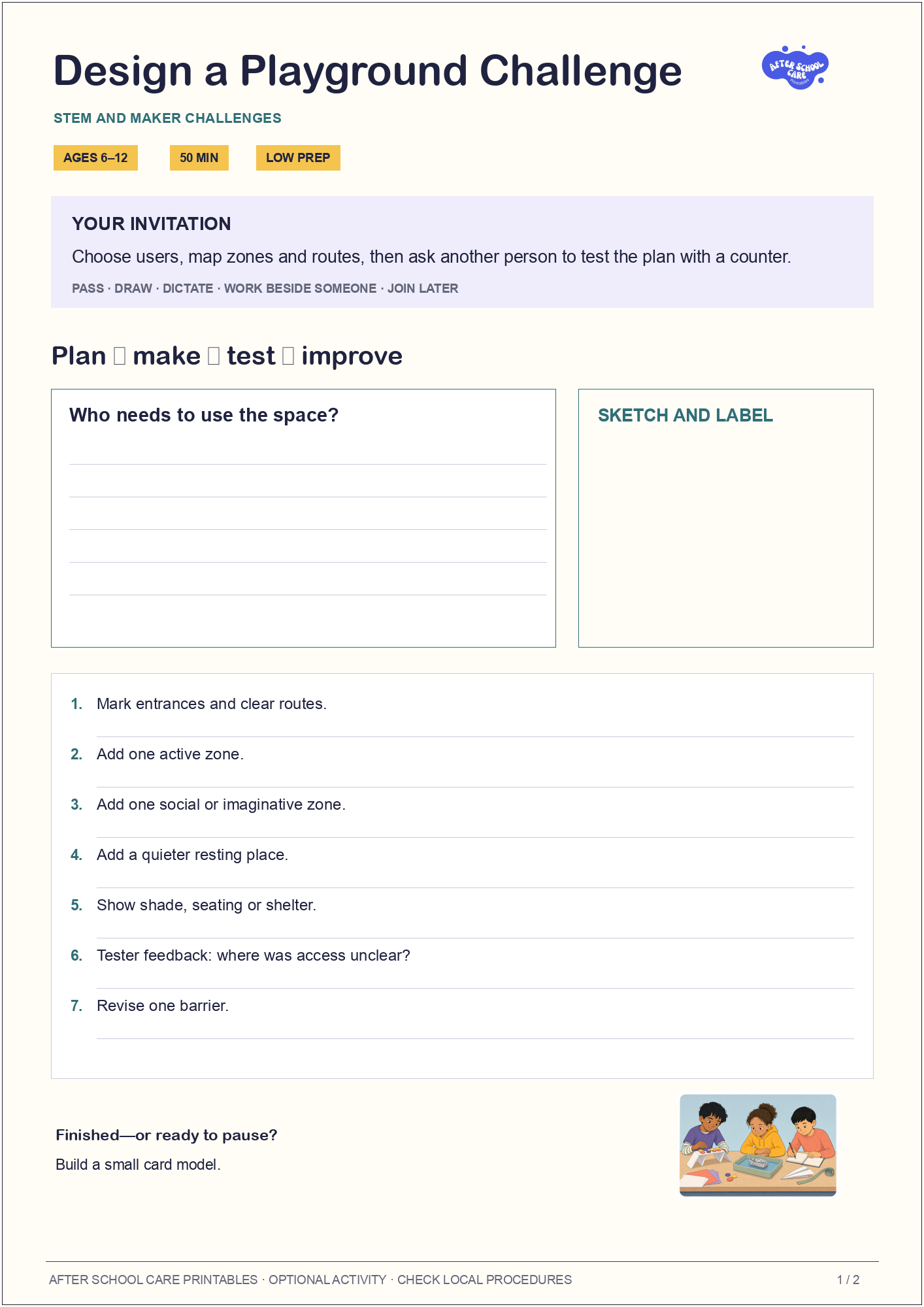
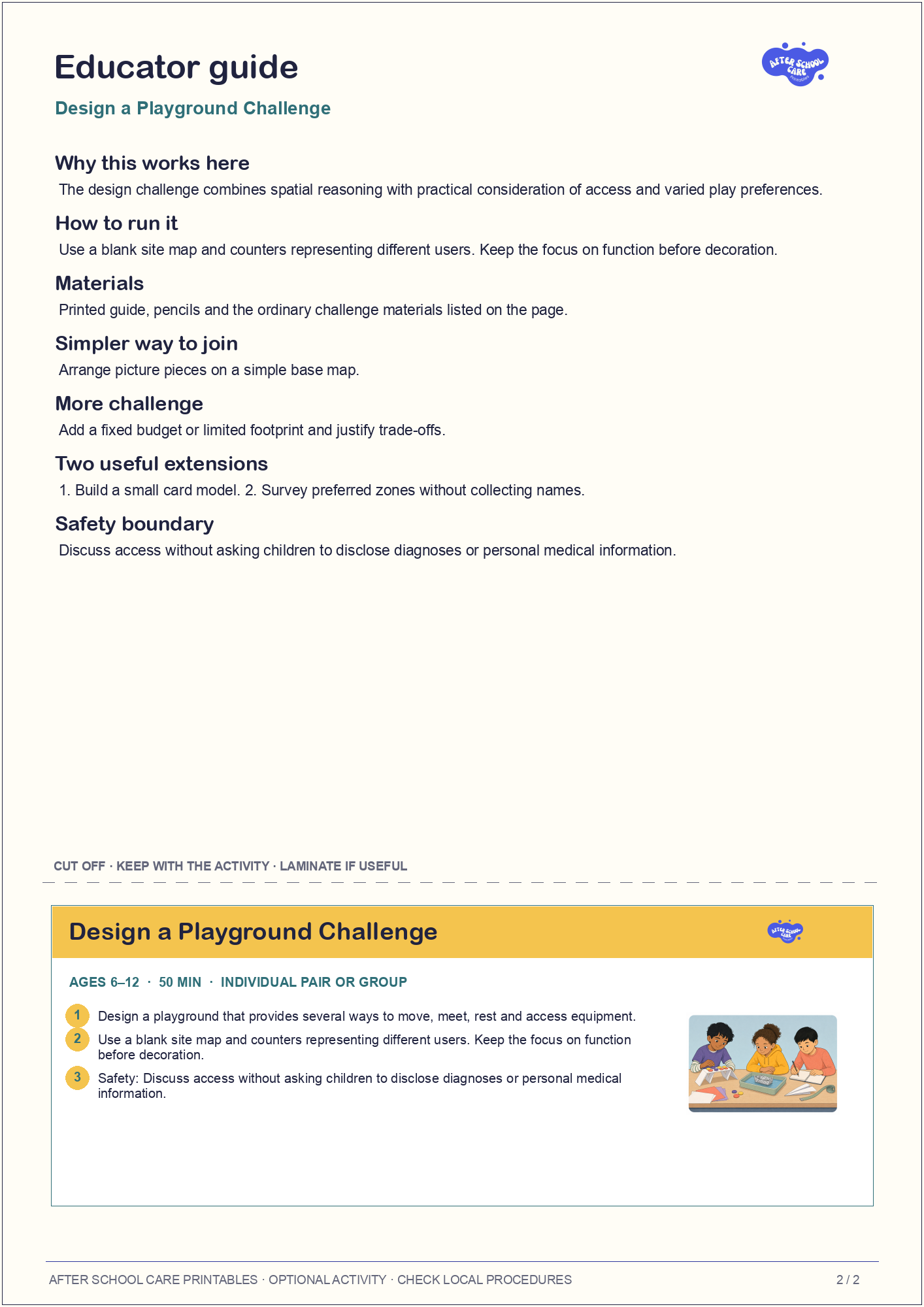
Download 2-page practical printableCheck the preview, printing notes and licence before use.
When this resource is useful
The design challenge combines spatial reasoning with practical consideration of access and varied play preferences.
What children do
Choose users, map zones and routes, then ask another person to test the plan with a counter.
Materials and preparation
Materials: Printed guide, pencils and the ordinary challenge materials listed on the page.
Allow about 10 minutes to print and place the resource. The activity itself usually takes 50 minutes and can pause when the group needs to transition.
Run the activity
Use a blank site map and counters representing different users. Keep the focus on function before decoration.
The child-facing prompts are:
- Who needs to use the space?
- Mark entrances and clear routes.
- Add one active zone.
- Add one social or imaginative zone.
- Add a quieter resting place.
- Show shade, seating or shelter.
- Tester feedback: where was access unclear?
- Revise one barrier.
Adapt participation
Simpler way to join: Arrange picture pieces on a simple base map.
More challenge: Add a fixed budget or limited footprint and justify trade-offs.
Children may draw, dictate, point, work beside a peer, observe or join later. Start, Explore and Extend labels describe task routes, not children.
Extend the idea
- Build a small card model.
- Survey preferred zones without collecting names.
Safety and privacy
Discuss access without asking children to disclose diagnoses or personal medical information.
Learning opportunities
Look for planning, testing, evidence, measurement and design revision. Record what children choose, explain, test or revise rather than treating completion as proof of learning.
Checking an open-ended response
There is no single required answer. A useful response follows the printed condition and can be explained, demonstrated or revised by the child.
Printing notes
Print at actual size on A4 paper. Page one is child-facing. Page two contains educator guidance and a dashed cut-off reference card that can be kept with the activity or laminated.