Resource
Paper Bridge Design Challenge
Build a paper bridge that spans a 20-centimetre gap and test how many counters it holds. Includes a two-page A4 printable, specific educator guidance, adaptations and a cut-off quick-reference card.
Ready for a real OSHC session
Preview both printable pages
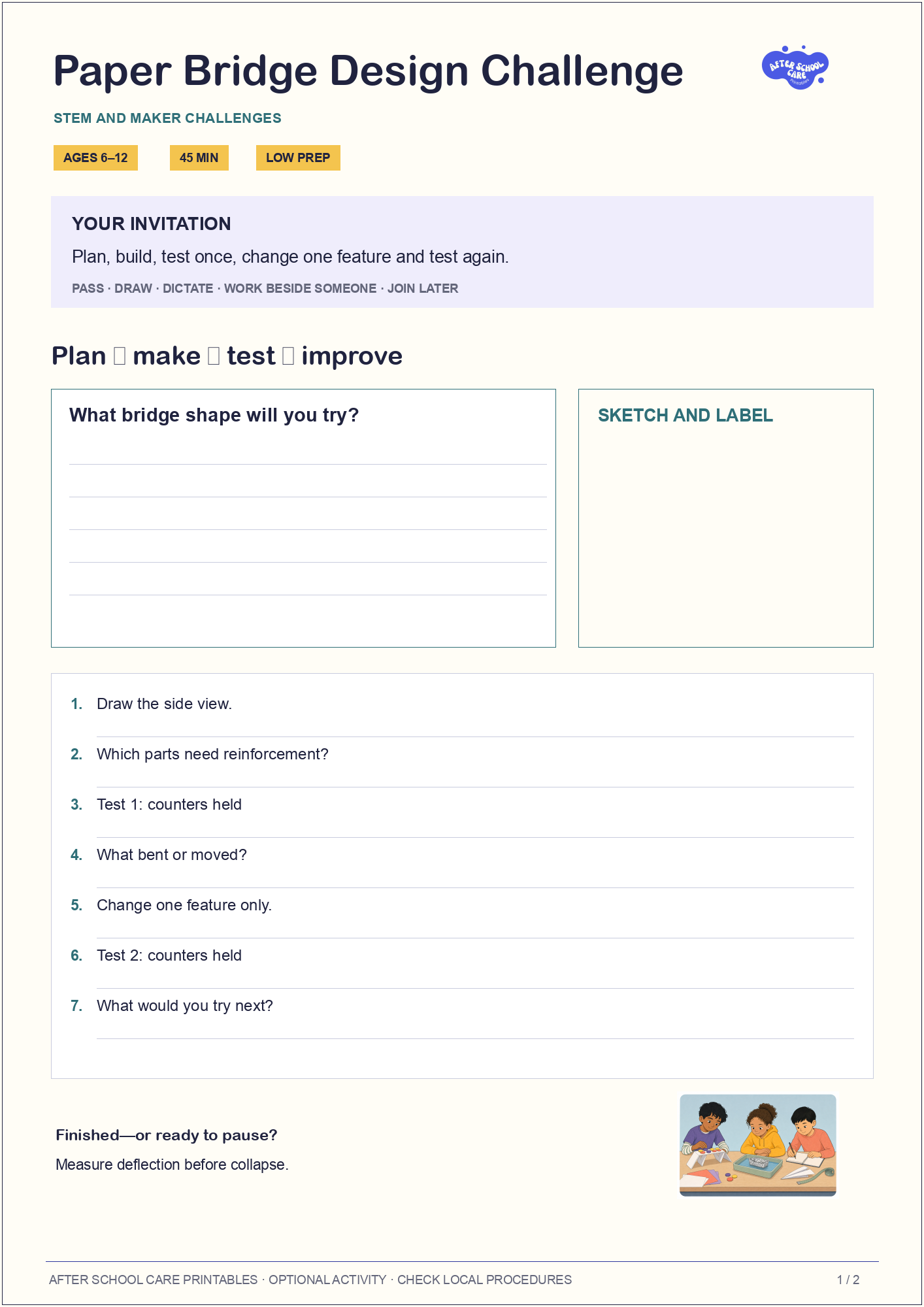
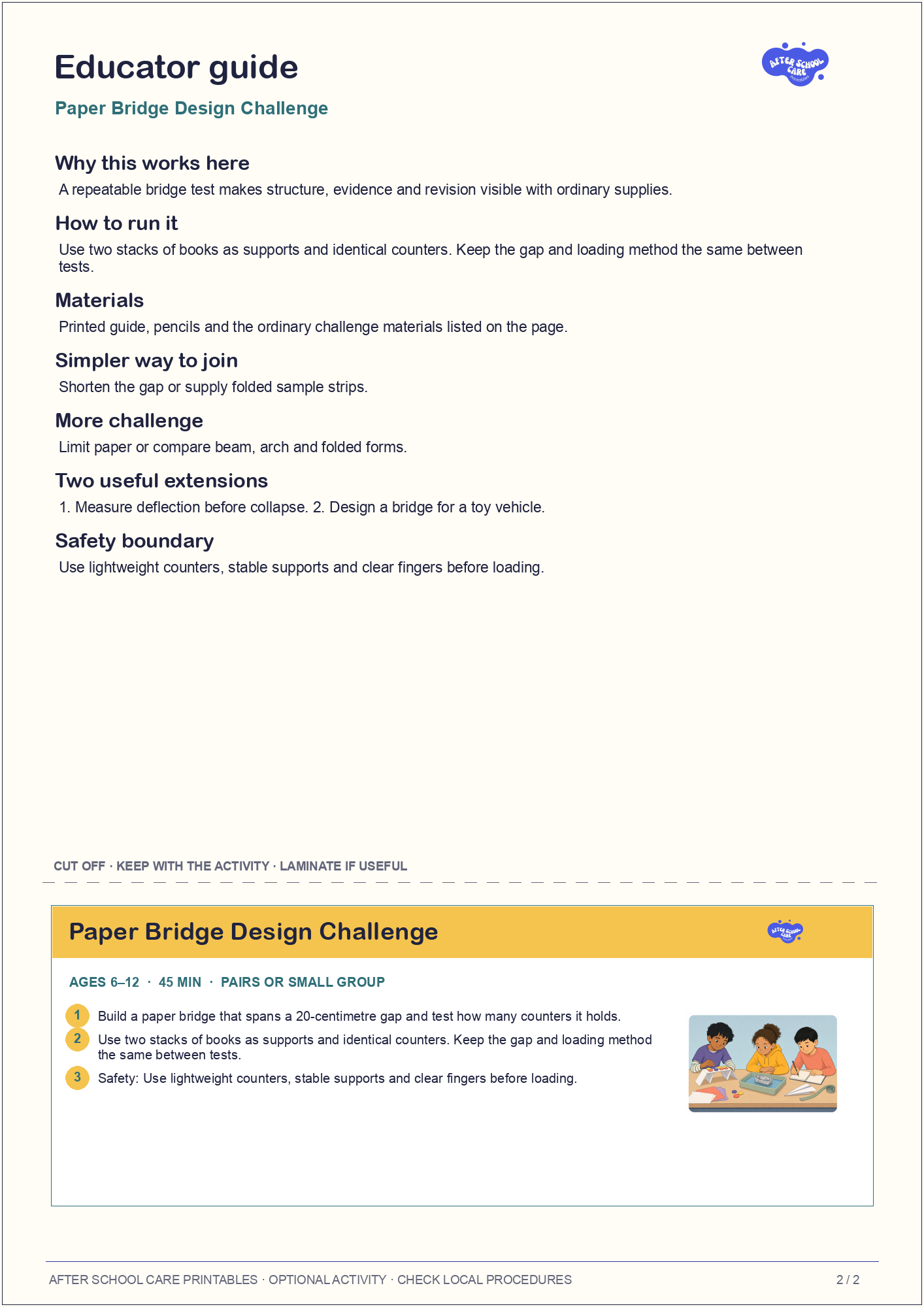
Download 2-page practical printableCheck the preview, printing notes and licence before use.
When this resource is useful
A repeatable bridge test makes structure, evidence and revision visible with ordinary supplies.
What children do
Plan, build, test once, change one feature and test again.
Materials and preparation
Materials: Printed guide, pencils and the ordinary challenge materials listed on the page.
Allow about 10 minutes to print and place the resource. The activity itself usually takes 45 minutes and can pause when the group needs to transition.
Run the activity
Use two stacks of books as supports and identical counters. Keep the gap and loading method the same between tests.
The child-facing prompts are:
- What bridge shape will you try?
- Draw the side view.
- Which parts need reinforcement?
- Test 1: counters held
- What bent or moved?
- Change one feature only.
- Test 2: counters held
- What would you try next?
Adapt participation
Simpler way to join: Shorten the gap or supply folded sample strips.
More challenge: Limit paper or compare beam, arch and folded forms.
Children may draw, dictate, point, work beside a peer, observe or join later. Start, Explore and Extend labels describe task routes, not children.
Extend the idea
- Measure deflection before collapse.
- Design a bridge for a toy vehicle.
Safety and privacy
Use lightweight counters, stable supports and clear fingers before loading.
Learning opportunities
Look for planning, testing, evidence, measurement and design revision. Record what children choose, explain, test or revise rather than treating completion as proof of learning.
Checking an open-ended response
There is no single required answer. A useful response follows the printed condition and can be explained, demonstrated or revised by the child.
Printing notes
Print at actual size on A4 paper. Page one is child-facing. Page two contains educator guidance and a dashed cut-off reference card that can be kept with the activity or laminated.