Resource
Preferential Voting Practice – Fictional House Ballot
Practise numbering every box on a fictional House of Representatives-style ballot in preference order. Free one-page A4 activity with educator guidance and checked answers.
Print, solve and discuss
Preview the complete activity page
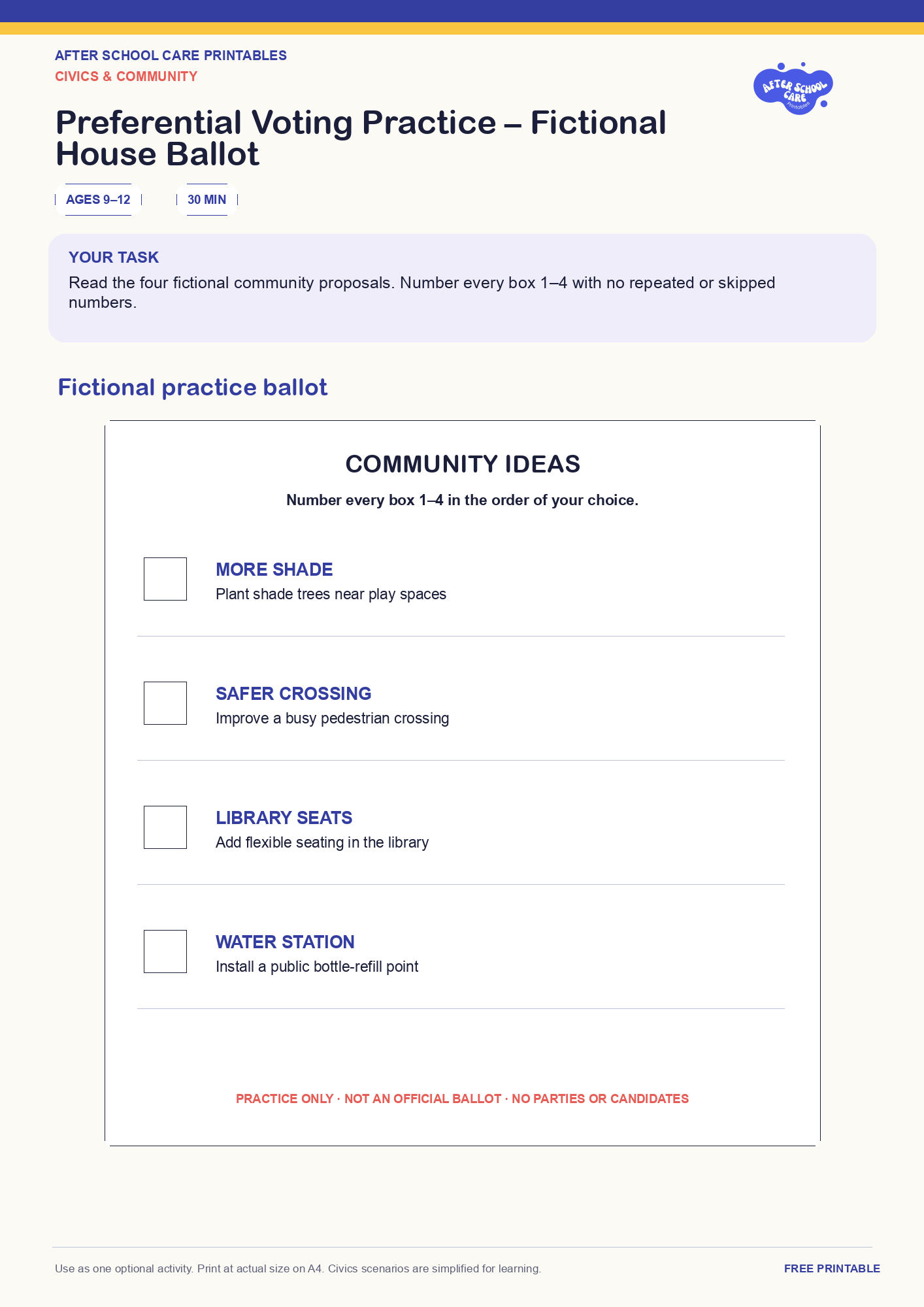
Download one-page A4 worksheetCheck the preview, printing notes and licence before use.
A practical Australian civics and community activity
Practise numbering every box on a fictional House of Representatives-style ballot in preference order. The printable gives children a specific task, visible response space and enough information to begin without a long educator explanation.
What children do
Read the four fictional community proposals. Number every box 1–4 with no repeated or skipped numbers.
Prepare and facilitate
Materials: Printed worksheet, pencil and optional colouring tools. Allow about two minutes to print and place the page. The activity usually takes 30 minutes.
State that the page is an educational mock-up, not an official ballot. Focus on formality, not political persuasion.
Keep examples fictional. Do not ask children to share household income, access to money, political preferences, addresses or family voting choices.
Answer guide
- A practice response is complete when every box has one of 1, 2, 3 and 4, each used once.
- There is no preferred proposal and no political party is represented.
Adapt participation
Simpler way to join: Read the task aloud, complete one example together and allow pointing, moving tokens or dictating instead of writing.
More challenge: Create four new fictional proposals and run a transparent classroom count using an educator-selected method.
Learning opportunities
Look for civic knowledge, sequencing, evidence and respectful community participation. Ask a child to show a match, calculation, sequence or reason; completion alone is not evidence of understanding.
Useful educator prompts
- What information on the page helps you begin?
- How could you check that match, total or sequence?
- Which part is a fact, and which part is a choice or opinion?
Fact-check sources
Printing notes
Print at actual size on A4 paper. The worksheet is ink-friendly and uses simplified diagrams rather than reproductions of banknotes, coins, official ballot papers or government artwork.