Resource
Compost helpers – Garden Explorers Major Activity
Help children explore careful observation, classification, habitat thinking and evidence-based explanation through Compost helpers, with a purposeful setup, clear educator prompts and flexible ways to participate.
Ready to plan and make
Preview the two-page activity guide
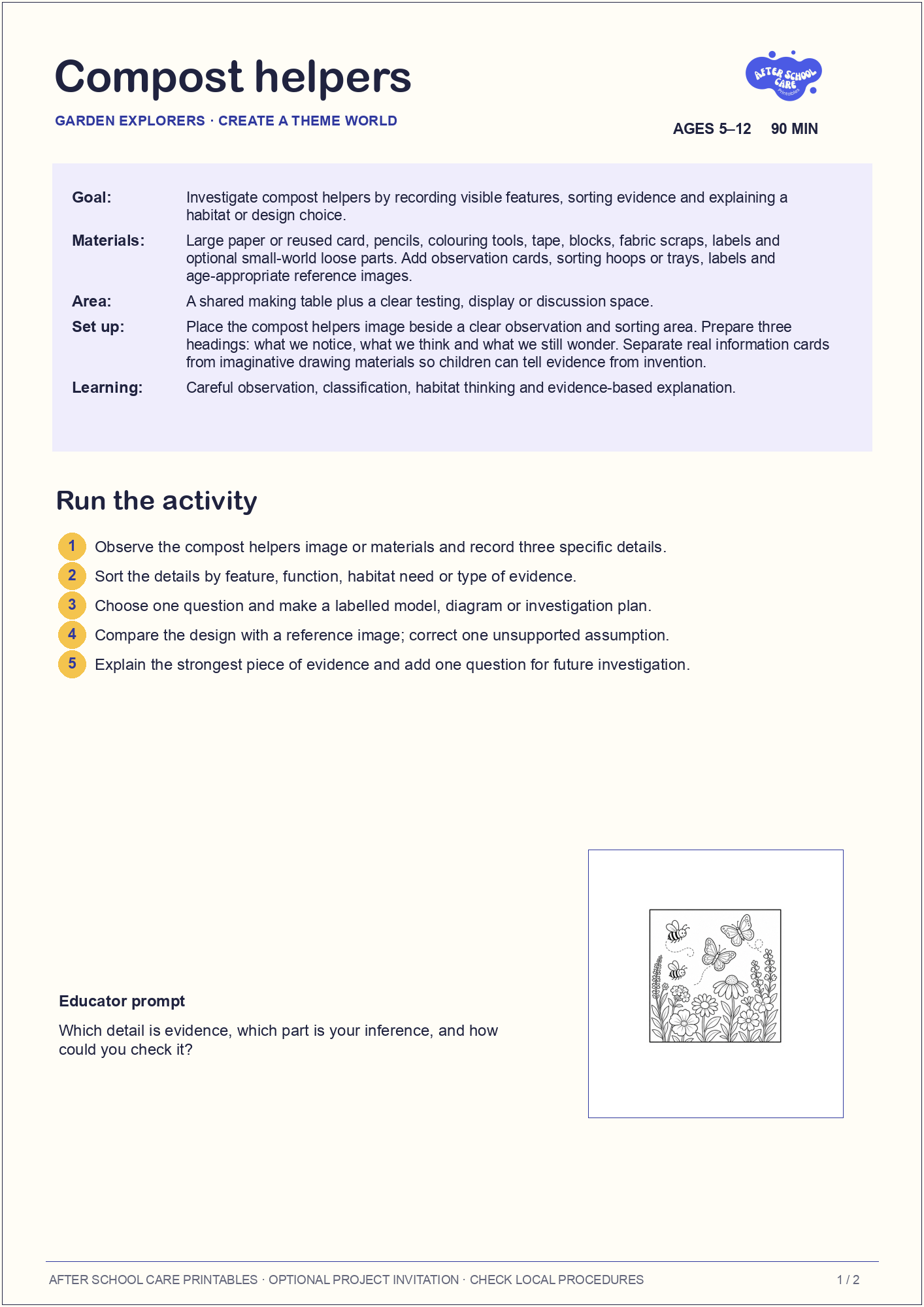
Download 2-page activity guideCheck the preview, printing notes and licence before use.
A substantial Garden Explorers project
Compost helpers is a Create a theme world designed to stay available for about 90 minutes. Children investigate careful observation, classification, habitat thinking and evidence-based explanation through a concrete shared task rather than completing identical work.
Educational purpose
This invitation gives children opportunities to develop careful observation, classification, habitat thinking and evidence-based explanation. Look for the decisions children make, the language they use to explain an idea and the evidence they notice after trying it. A finished model is optional; the planning, testing and discussion are valuable parts of the experience.
Goal
Investigate compost helpers by recording visible features, sorting evidence and explaining a habitat or design choice.
Materials
Large paper or reused card, pencils, colouring tools, tape, blocks, fabric scraps, labels and optional small-world loose parts. Add observation cards, sorting hoops or trays, labels and age-appropriate reference images.
Set up
- Place the compost helpers image beside a clear observation and sorting area.
- Prepare three headings: what we notice, what we think and what we still wonder.
- Separate real information cards from imaginative drawing materials so children can tell evidence from invention.
Run the activity
- Observe the compost helpers image or materials and record three specific details.
- Sort the details by feature, function, habitat need or type of evidence.
- Choose one question and make a labelled model, diagram or investigation plan.
- Compare the design with a reference image; correct one unsupported assumption.
- Explain the strongest piece of evidence and add one question for future investigation.
Educator prompt
Which detail is evidence, which part is your inference, and how could you check it?
Adapt participation
Offer picture choices, a magnifier, two sorting categories and drawing or pointing instead of written labels.
Extend the challenge
Add a life-cycle, food-web, measurement or habitat-change question and cite the reference used.
Safety
- Check tools, materials, floor space and supervision against local service procedures.
- Keep walkways clear and use only clean, lightweight construction materials suitable for the children present.
- Participation, observing and an alternative activity remain available choices.
Reflection
What did close observation change about your first idea?
Printing notes
The two-page A4 guide follows the same clean format as the printable physical games. Page two includes a cut-off quick-reference card that can be stored with the activity materials or laminated.