Resource
Community transport – Future City Major Activity
Help children explore design thinking, sequencing, systems reasoning and iterative problem-solving through Community transport, with a purposeful setup, clear educator prompts and flexible ways to participate.
Ready to plan and make
Preview the two-page activity guide
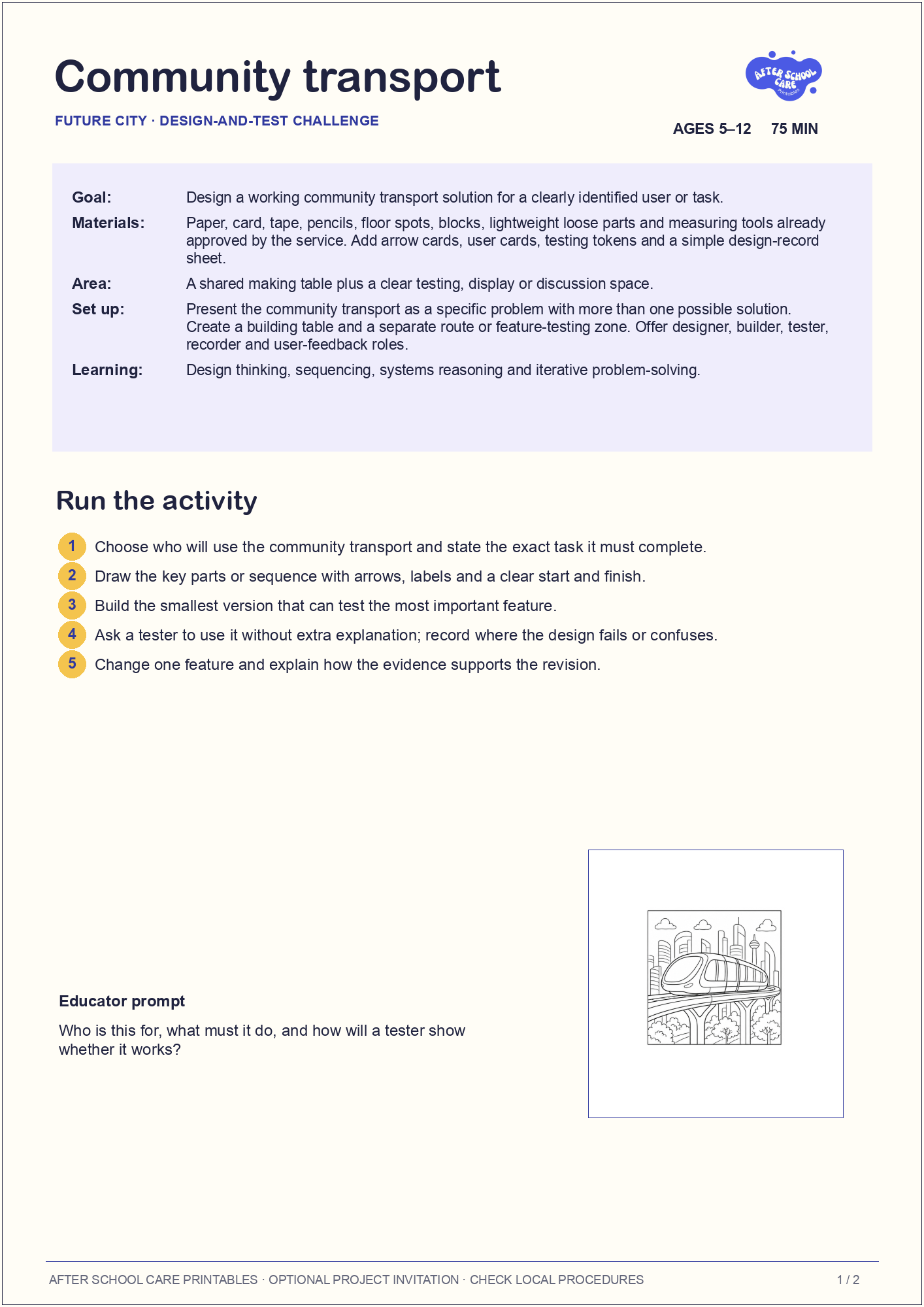
Download 2-page activity guideCheck the preview, printing notes and licence before use.
A substantial Future City project
Community transport is a Design-and-test challenge designed to stay available for about 75 minutes. Children investigate design thinking, sequencing, systems reasoning and iterative problem-solving through a concrete shared task rather than completing identical work.
Educational purpose
This invitation gives children opportunities to develop design thinking, sequencing, systems reasoning and iterative problem-solving. Look for the decisions children make, the language they use to explain an idea and the evidence they notice after trying it. A finished model is optional; the planning, testing and discussion are valuable parts of the experience.
Goal
Design a working community transport solution for a clearly identified user or task.
Materials
Paper, card, tape, pencils, floor spots, blocks, lightweight loose parts and measuring tools already approved by the service. Add arrow cards, user cards, testing tokens and a simple design-record sheet.
Set up
- Present the community transport as a specific problem with more than one possible solution.
- Create a building table and a separate route or feature-testing zone.
- Offer designer, builder, tester, recorder and user-feedback roles.
Run the activity
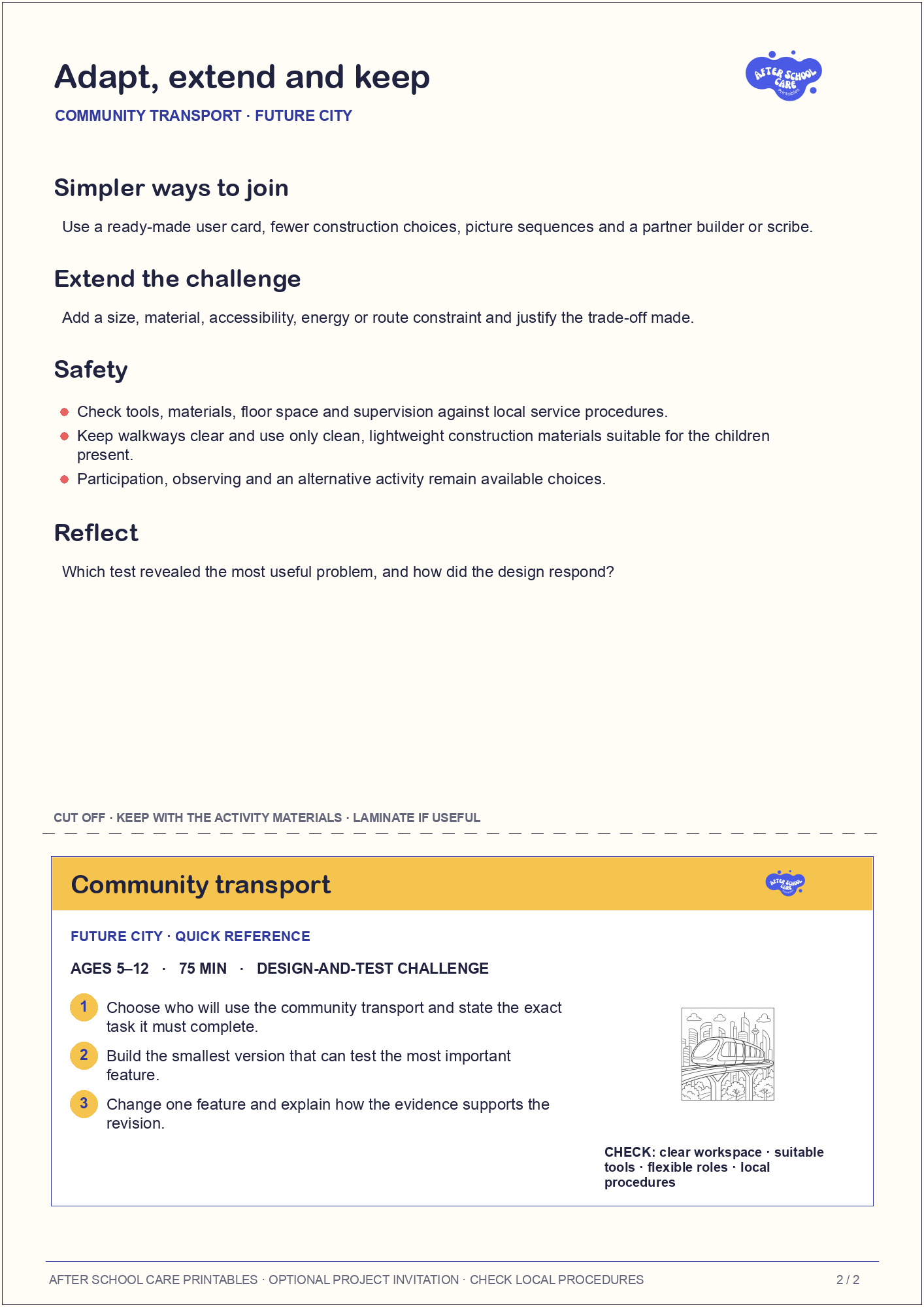
- Choose who will use the community transport and state the exact task it must complete.
- Draw the key parts or sequence with arrows, labels and a clear start and finish.
- Build the smallest version that can test the most important feature.
- Ask a tester to use it without extra explanation; record where the design fails or confuses.
- Change one feature and explain how the evidence supports the revision.
Educator prompt
Who is this for, what must it do, and how will a tester show whether it works?
Adapt participation
Use a ready-made user card, fewer construction choices, picture sequences and a partner builder or scribe.
Extend the challenge
Add a size, material, accessibility, energy or route constraint and justify the trade-off made.
Safety
- Check tools, materials, floor space and supervision against local service procedures.
- Keep walkways clear and use only clean, lightweight construction materials suitable for the children present.
- Participation, observing and an alternative activity remain available choices.
Reflection
Which test revealed the most useful problem, and how did the design respond?
Printing notes
The two-page A4 guide follows the same clean format as the printable physical games. Page two includes a cut-off quick-reference card that can be stored with the activity materials or laminated.