Resource
Friendly rover repair – Space Station Major Activity
Help children explore systems thinking, scientific imagination, scale and evidence-informed design through Friendly rover repair, with a purposeful setup, clear educator prompts and flexible ways to participate.
Ready to plan and make
Preview the two-page activity guide

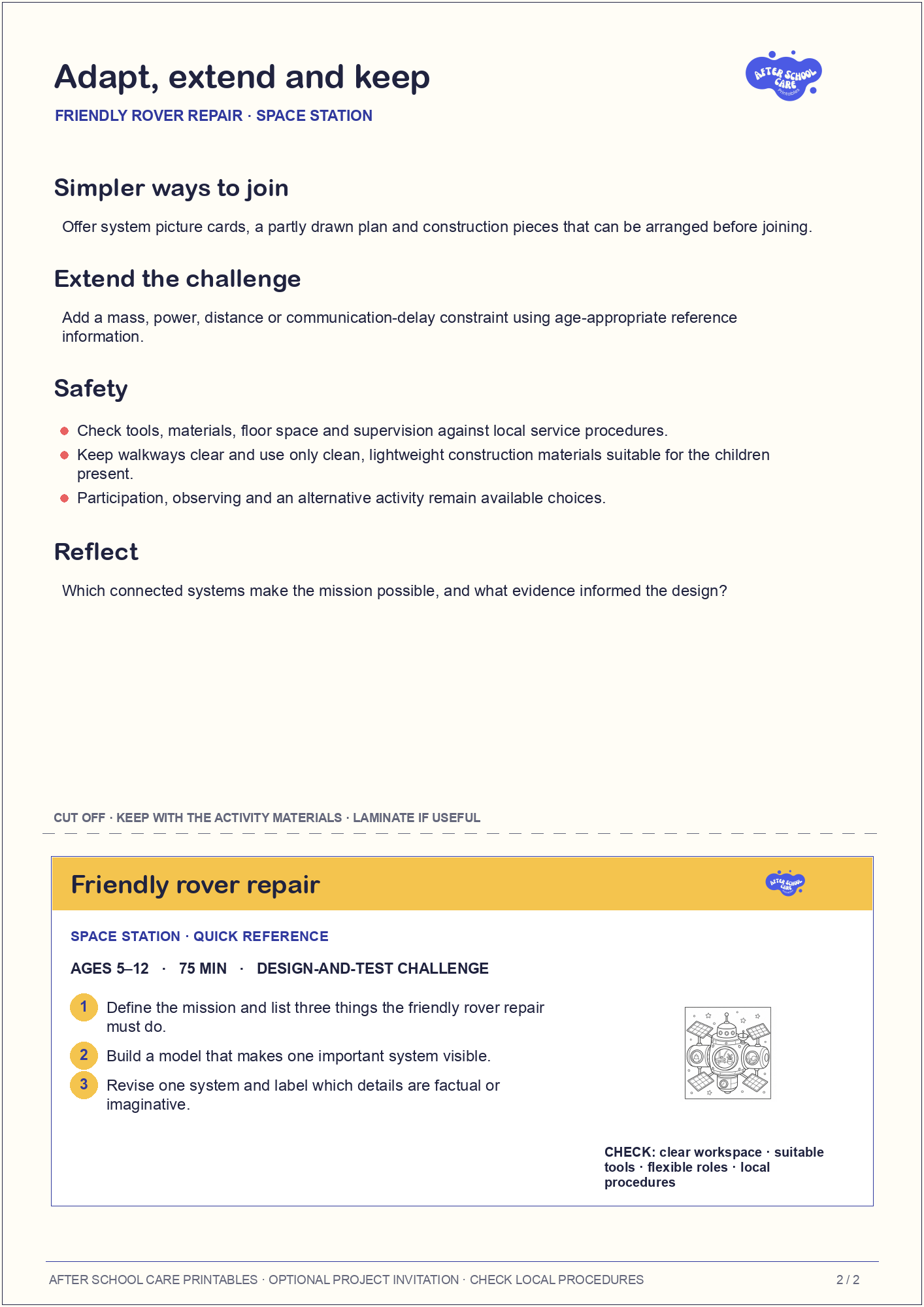
Download 2-page activity guideCheck the preview, printing notes and licence before use.
A substantial Space Station project
Friendly rover repair is a Design-and-test challenge designed to stay available for about 75 minutes. Children investigate systems thinking, scientific imagination, scale and evidence-informed design through a concrete shared task rather than completing identical work.
Educational purpose
This invitation gives children opportunities to develop systems thinking, scientific imagination, scale and evidence-informed design. Look for the decisions children make, the language they use to explain an idea and the evidence they notice after trying it. A finished model is optional; the planning, testing and discussion are valuable parts of the experience.
Goal
Create a labelled model for friendly rover repair that shows the systems people or equipment would need to complete the mission.
Materials
Paper, card, tape, pencils, floor spots, blocks, lightweight loose parts and measuring tools already approved by the service. Add mission cards, system labels and reference images of real space technology.
Set up
- Choose a clear mission for friendly rover repair, such as travel, research, repair or growing food.
- Prepare system cards for power, communication, protection, movement and life support where relevant.
- Separate real space facts from imaginative story additions.
Run the activity
- Define the mission and list three things the friendly rover repair must do.
- Sketch the main systems and use arrows to show how two parts connect.
- Build a model that makes one important system visible.
- Test the model against a mission problem such as lost power or rough terrain.
- Revise one system and label which details are factual or imaginative.
Educator prompt
Which system is essential to the mission, and what happens if it fails?
Adapt participation
Offer system picture cards, a partly drawn plan and construction pieces that can be arranged before joining.
Extend the challenge
Add a mass, power, distance or communication-delay constraint using age-appropriate reference information.
Safety
- Check tools, materials, floor space and supervision against local service procedures.
- Keep walkways clear and use only clean, lightweight construction materials suitable for the children present.
- Participation, observing and an alternative activity remain available choices.
Reflection
Which connected systems make the mission possible, and what evidence informed the design?
Printing notes
The two-page A4 guide follows the same clean format as the printable physical games. Page two includes a cut-off quick-reference card that can be stored with the activity materials or laminated.