Resource
Code-breaking desk – Secret Agent Academy Major Activity
Help children explore logical reasoning, rule clarity, mapping or sequencing and constructive peer feedback through Code-breaking desk, with a purposeful setup, clear educator prompts and flexible ways to participate.
Ready to plan and make
Preview the two-page activity guide
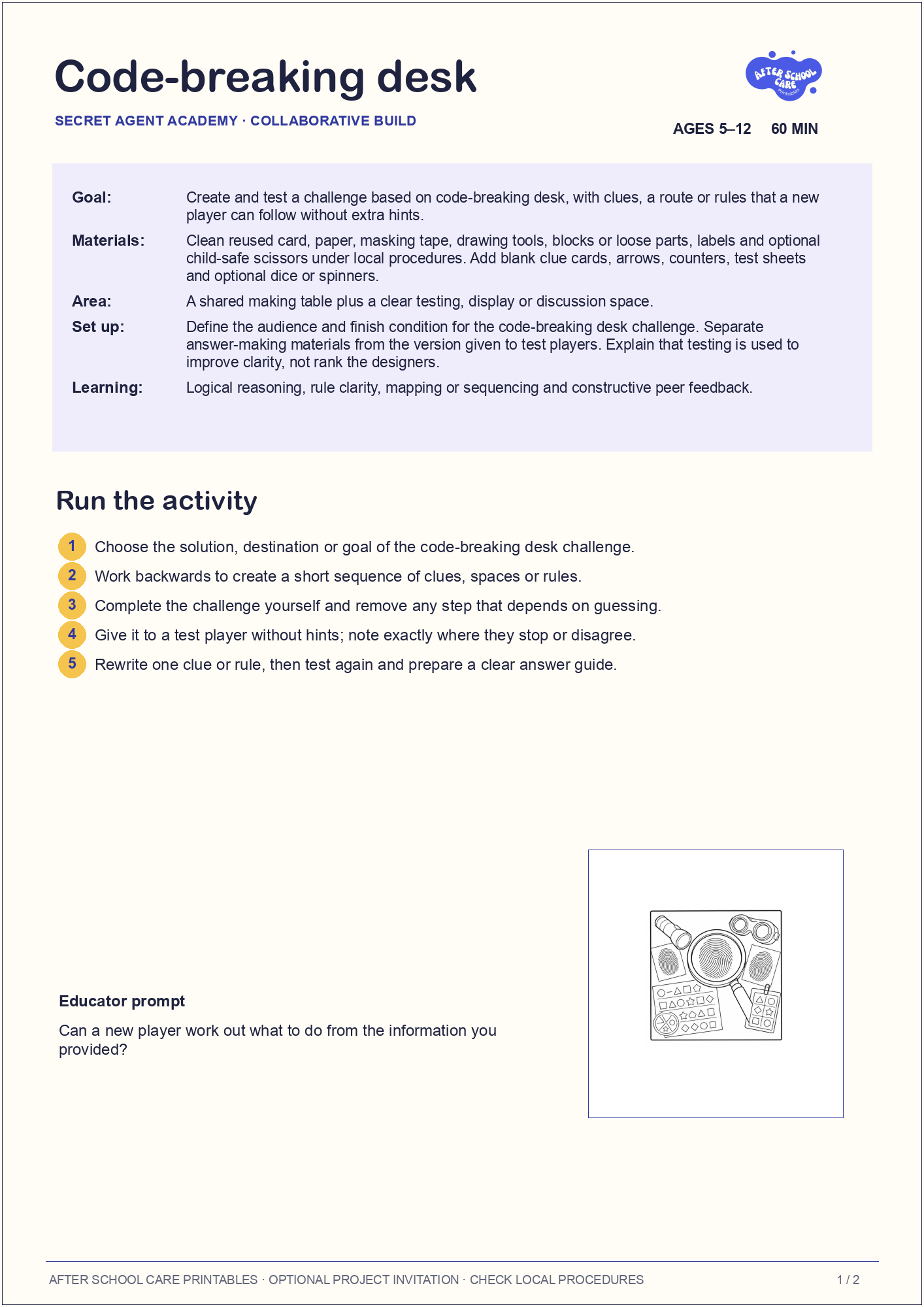
Download 2-page activity guideCheck the preview, printing notes and licence before use.
A substantial Secret Agent Academy project
Code-breaking desk is a Collaborative build designed to stay available for about 60 minutes. Children investigate logical reasoning, rule clarity, mapping or sequencing and constructive peer feedback through a concrete shared task rather than completing identical work.
Educational purpose
This invitation gives children opportunities to develop logical reasoning, rule clarity, mapping or sequencing and constructive peer feedback. Look for the decisions children make, the language they use to explain an idea and the evidence they notice after trying it. A finished model is optional; the planning, testing and discussion are valuable parts of the experience.
Goal
Create and test a challenge based on code-breaking desk, with clues, a route or rules that a new player can follow without extra hints.
Materials
Clean reused card, paper, masking tape, drawing tools, blocks or loose parts, labels and optional child-safe scissors under local procedures. Add blank clue cards, arrows, counters, test sheets and optional dice or spinners.
Set up
- Define the audience and finish condition for the code-breaking desk challenge.
- Separate answer-making materials from the version given to test players.
- Explain that testing is used to improve clarity, not rank the designers.
Run the activity
- Choose the solution, destination or goal of the code-breaking desk challenge.
- Work backwards to create a short sequence of clues, spaces or rules.
- Complete the challenge yourself and remove any step that depends on guessing.
- Give it to a test player without hints; note exactly where they stop or disagree.
- Rewrite one clue or rule, then test again and prepare a clear answer guide.
Educator prompt
Can a new player work out what to do from the information you provided?
Adapt participation
Use a shorter route, picture clues, matching choices and a partner who can read instructions aloud.
Extend the challenge
Add branching choices, a scoring explanation or two difficulty levels that use the same theme.
Safety
- Check tools, materials, floor space and supervision against local service procedures.
- Keep walkways clear and use only clean, lightweight construction materials suitable for the children present.
- Participation, observing and an alternative activity remain available choices.
Reflection
Which test-player question showed that a clue or rule needed improvement?
Printing notes
The two-page A4 guide follows the same clean format as the printable physical games. Page two includes a cut-off quick-reference card that can be stored with the activity materials or laminated.