Resource
Quiet Table Challenge Cards
Provide compact thinking, drawing and pattern choices at a lower-noise table. Includes a two-page A4 printable, specific educator guidance, adaptations and a cut-off quick-reference card.
Ready for a real OSHC session
Preview both printable pages
Download 2-page practical printableCheck the preview, printing notes and licence before use.
When this resource is useful
The cards make a quieter space purposeful without presenting it as punishment or therapy.
What children do
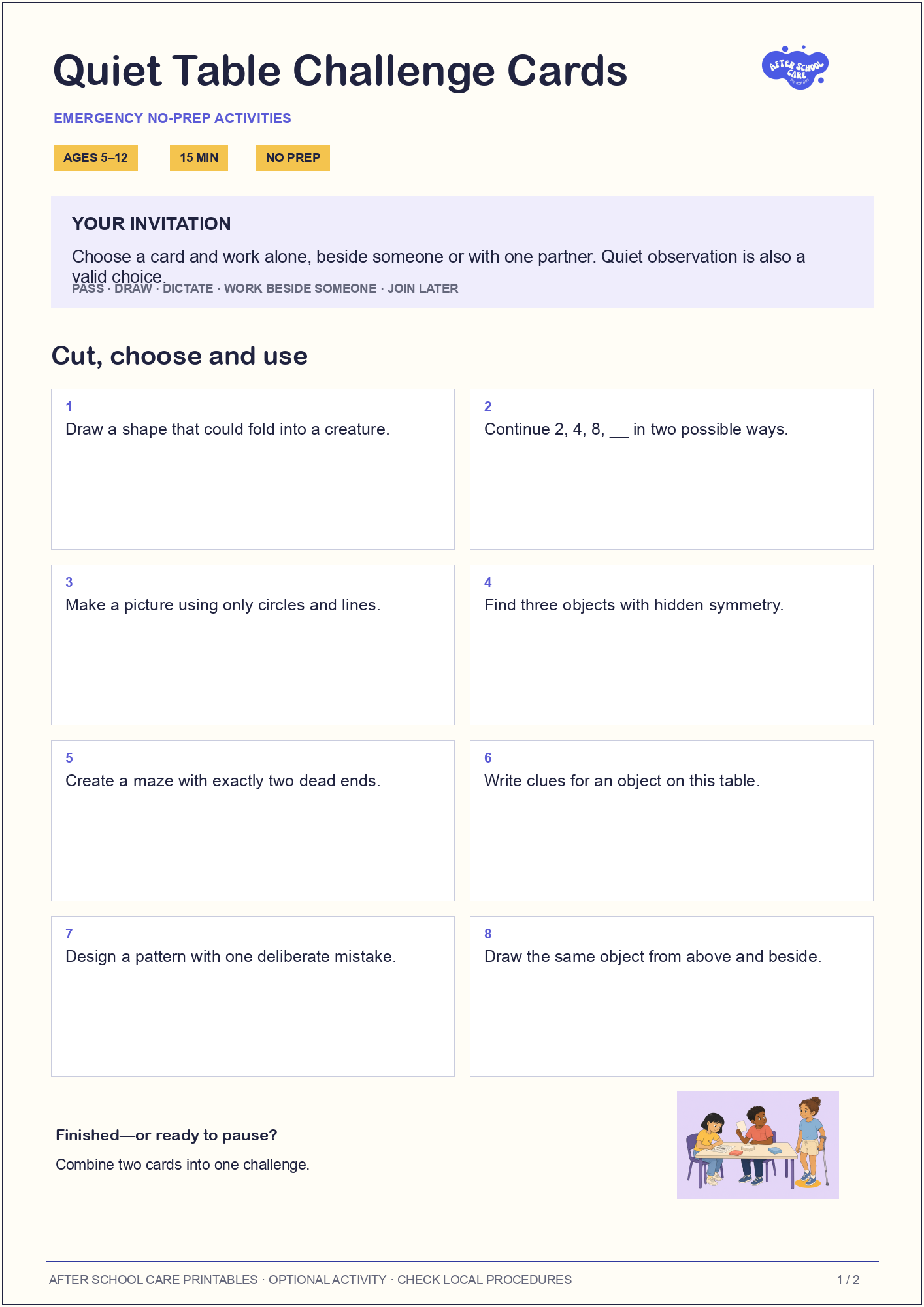
Choose a card and work alone, beside someone or with one partner. Quiet observation is also a valid choice.
Materials and preparation
Materials: Printed pages and pencils; use only the optional ordinary materials named on the page.
Allow about 2 minutes to print and place the resource. The activity itself usually takes 15 minutes and can pause when the group needs to transition.
Run the activity
Place four cards out at once and rotate only when a card is returned. Keep a blank-paper option available.
The child-facing prompts are:
- Draw a shape that could fold into a creature.
- Continue 2, 4, 8, __ in two possible ways.
- Make a picture using only circles and lines.
- Find three objects with hidden symmetry.
- Create a maze with exactly two dead ends.
- Write clues for an object on this table.
- Design a pattern with one deliberate mistake.
- Draw the same object from above and beside.
Adapt participation
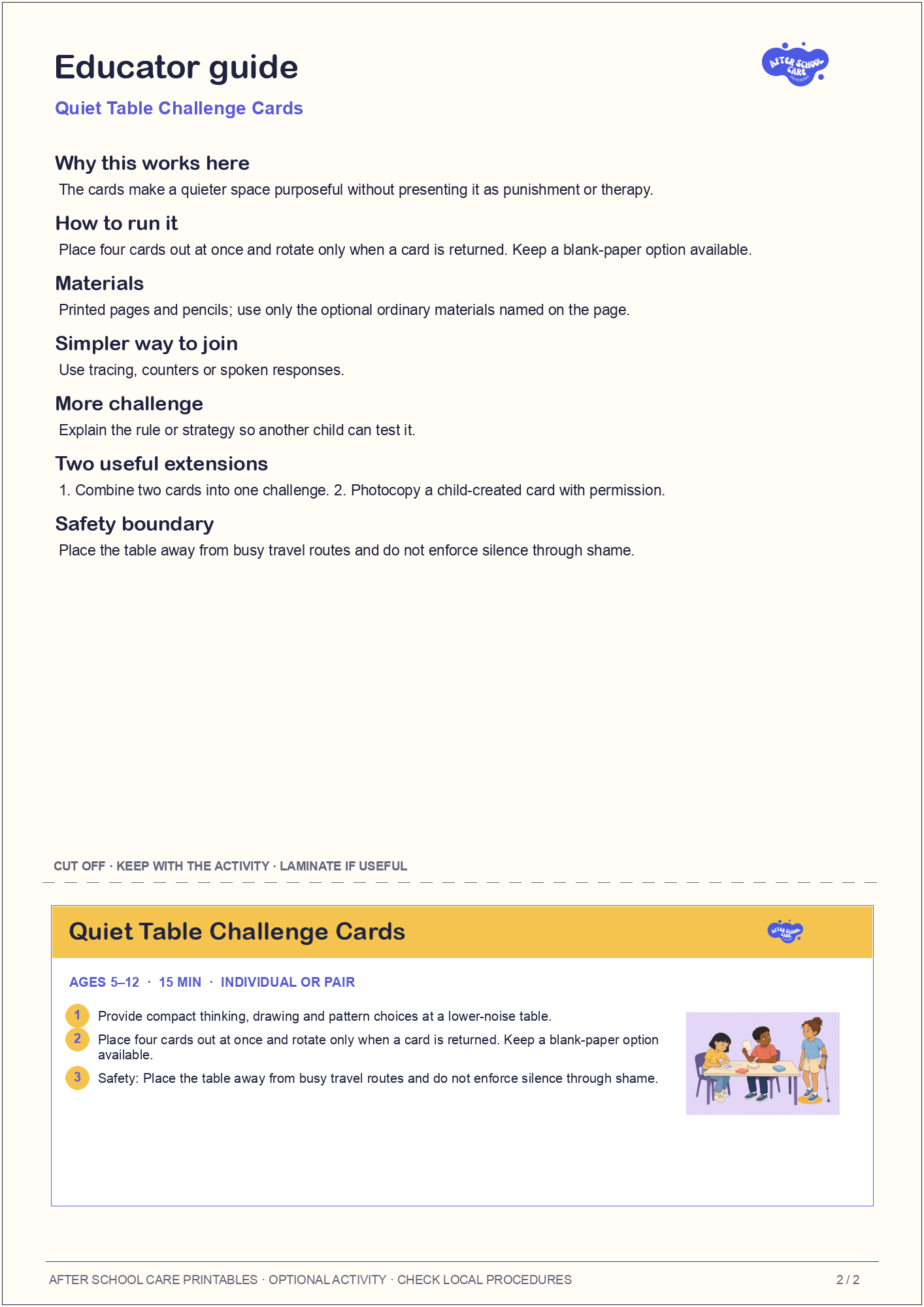
Simpler way to join: Use tracing, counters or spoken responses.
More challenge: Explain the rule or strategy so another child can test it.
Children may draw, dictate, point, work beside a peer, observe or join later. Start, Explore and Extend labels describe task routes, not children.
Extend the idea
- Combine two cards into one challenge.
- Photocopy a child-created card with permission.
Safety and privacy
Place the table away from busy travel routes and do not enforce silence through shame.
Learning opportunities
Look for choice, communication, creative thinking and independent engagement. Record what children choose, explain, test or revise rather than treating completion as proof of learning.
Checking an open-ended response
There is no single required answer. A useful response follows the printed condition and can be explained, demonstrated or revised by the child.
Printing notes
Print at actual size on A4 paper. Page one is child-facing. Page two contains educator guidance and a dashed cut-off reference card that can be kept with the activity or laminated.