Resource
Spider Adventure Course – Nursery Rhyme Adventures Major Activity
Help children explore cause and effect, route planning, positional language and collaborative testing through Spider Adventure Course, with a purposeful setup, clear educator prompts and flexible ways to participate.
Ready to plan and make
Preview the two-page activity guide
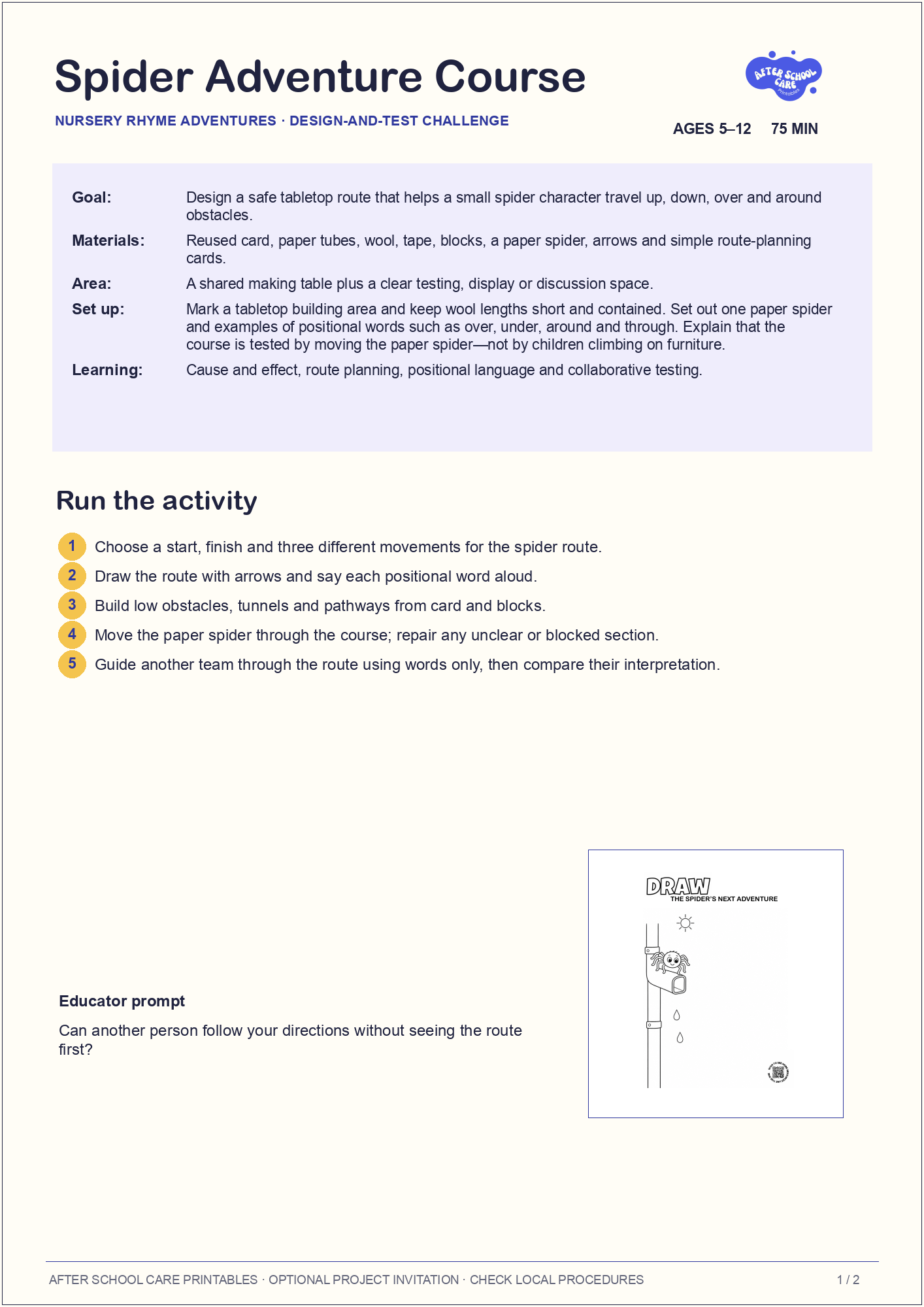
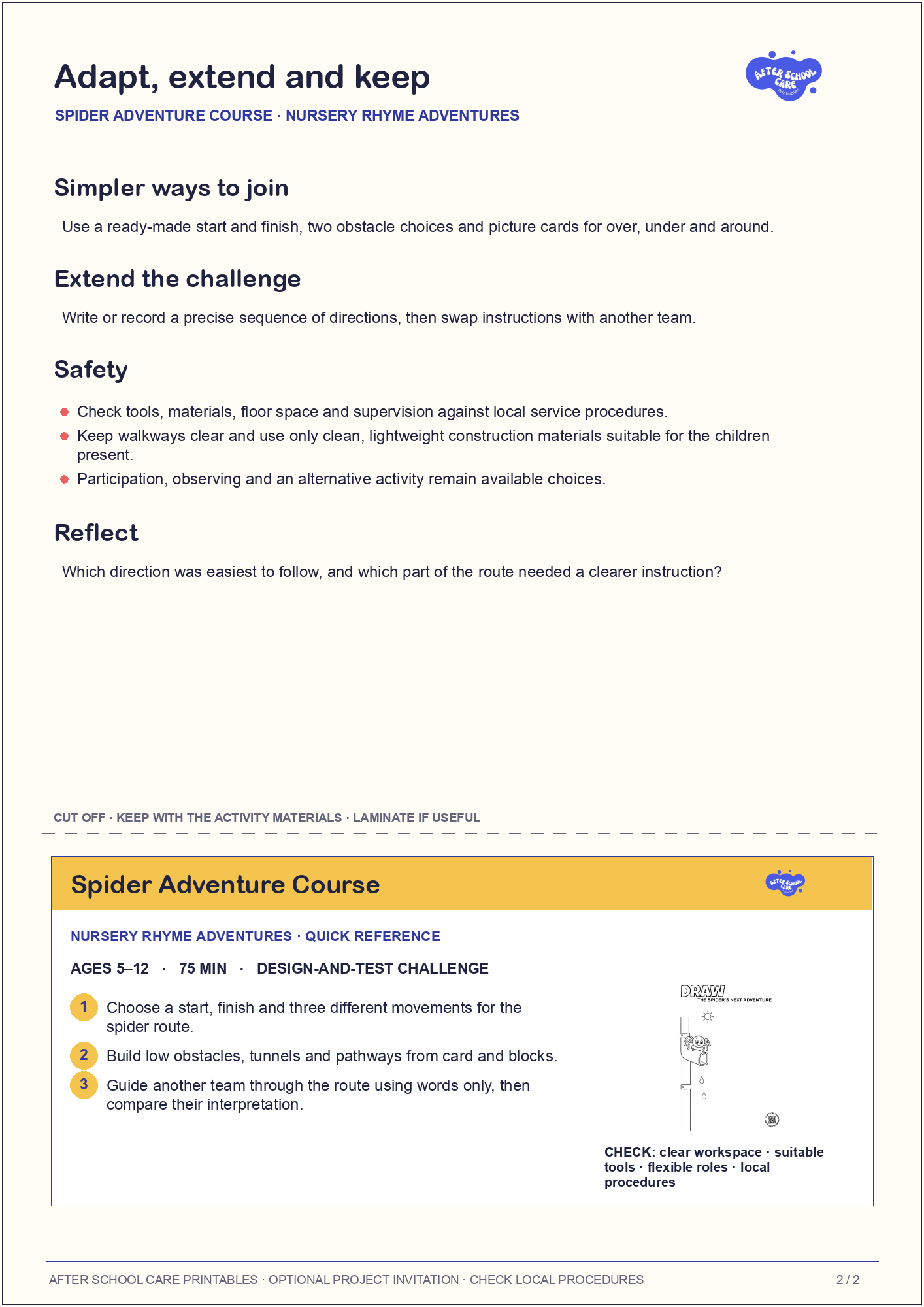
Download 2-page activity guideCheck the preview, printing notes and licence before use.
A substantial Nursery Rhyme Adventures project
Spider Adventure Course is a Design-and-test challenge designed to stay available for about 75 minutes. Children investigate cause and effect, route planning, positional language and collaborative testing through a concrete shared task rather than completing identical work.
Educational purpose
This invitation gives children opportunities to develop cause and effect, route planning, positional language and collaborative testing. Look for the decisions children make, the language they use to explain an idea and the evidence they notice after trying it. A finished model is optional; the planning, testing and discussion are valuable parts of the experience.
Goal
Design a safe tabletop route that helps a small spider character travel up, down, over and around obstacles.
Materials
Reused card, paper tubes, wool, tape, blocks, a paper spider, arrows and simple route-planning cards.
Set up
- Mark a tabletop building area and keep wool lengths short and contained.
- Set out one paper spider and examples of positional words such as over, under, around and through.
- Explain that the course is tested by moving the paper spider—not by children climbing on furniture.
Run the activity
- Choose a start, finish and three different movements for the spider route.
- Draw the route with arrows and say each positional word aloud.
- Build low obstacles, tunnels and pathways from card and blocks.
- Move the paper spider through the course; repair any unclear or blocked section.
- Guide another team through the route using words only, then compare their interpretation.
Educator prompt
Can another person follow your directions without seeing the route first?
Adapt participation
Use a ready-made start and finish, two obstacle choices and picture cards for over, under and around.
Extend the challenge
Write or record a precise sequence of directions, then swap instructions with another team.
Safety
- Check tools, materials, floor space and supervision against local service procedures.
- Keep walkways clear and use only clean, lightweight construction materials suitable for the children present.
- Participation, observing and an alternative activity remain available choices.
Reflection
Which direction was easiest to follow, and which part of the route needed a clearer instruction?
Printing notes
The two-page A4 guide follows the same clean format as the printable physical games. Page two includes a cut-off quick-reference card that can be stored with the activity materials or laminated.