Resource
Nature Explorer Field Journal
Record careful observations in a defined outdoor or window-view area without collecting living things. Includes a two-page A4 printable, specific educator guidance, adaptations and a cut-off quick-reference card.
Ready for a real OSHC session
Preview both printable pages
Download 2-page practical printableCheck the preview, printing notes and licence before use.
When this resource is useful
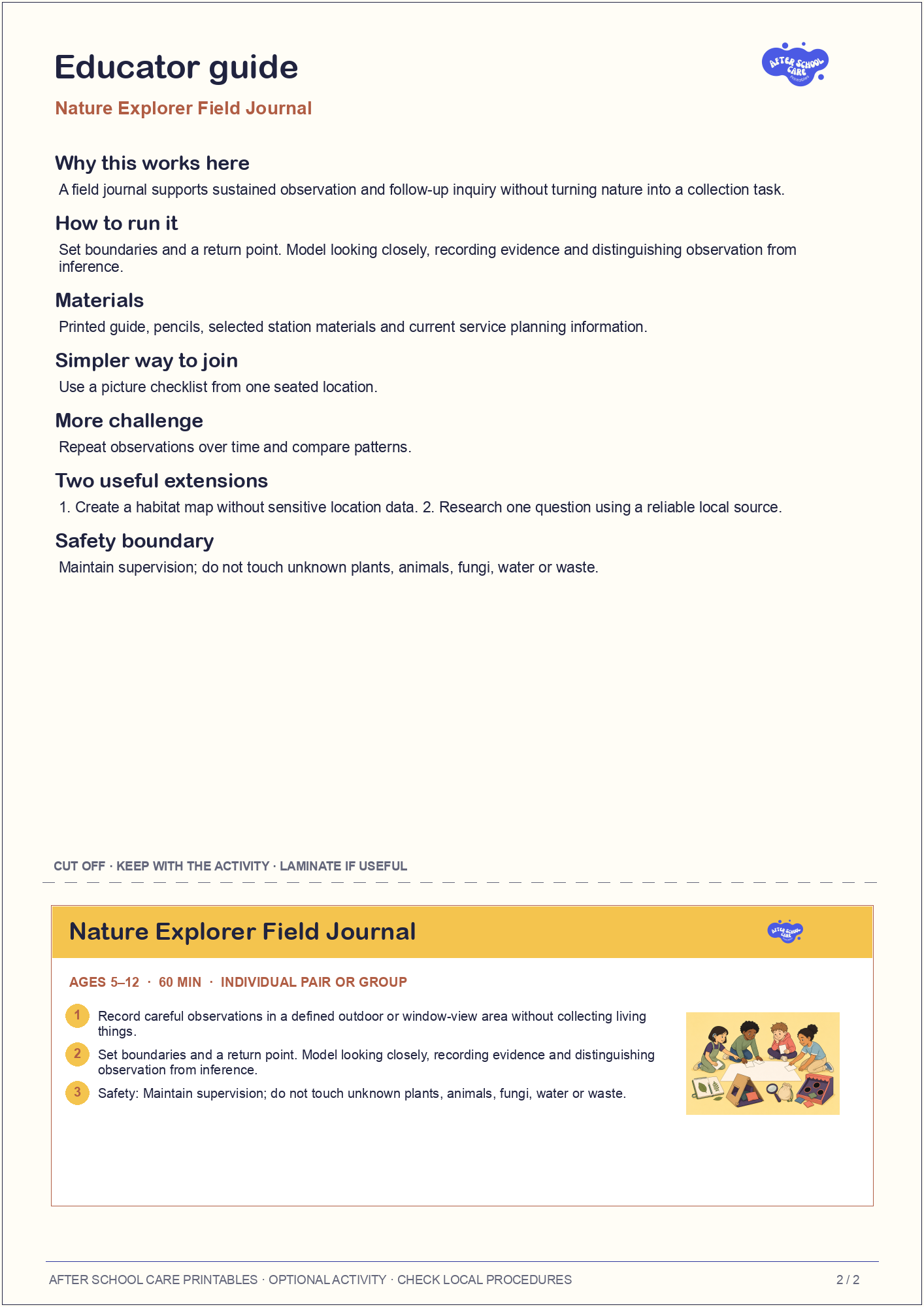
A field journal supports sustained observation and follow-up inquiry without turning nature into a collection task.
What children do
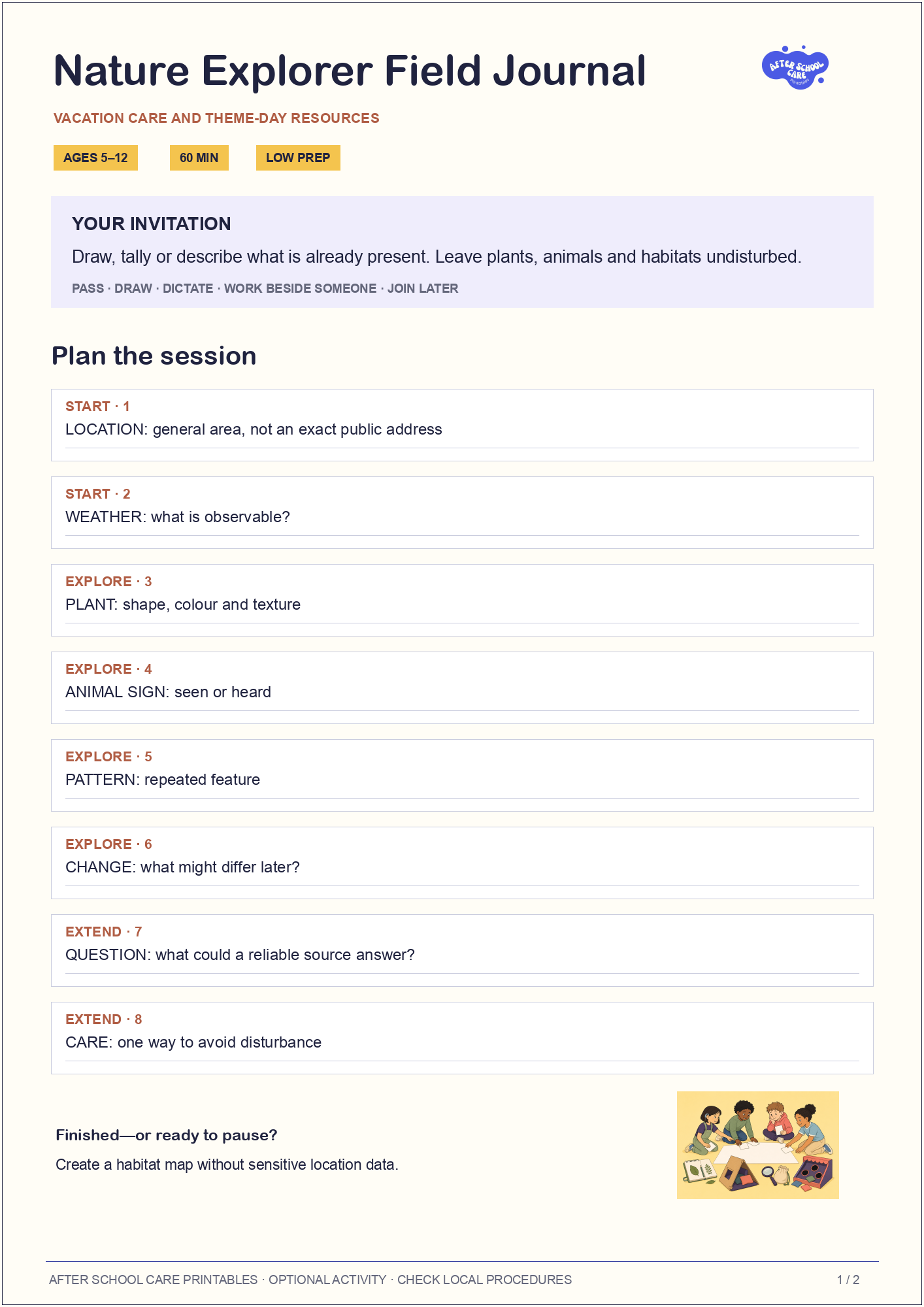
Draw, tally or describe what is already present. Leave plants, animals and habitats undisturbed.
Materials and preparation
Materials: Printed guide, pencils, selected station materials and current service planning information.
Allow about 10 minutes to print and place the resource. The activity itself usually takes 60 minutes and can pause when the group needs to transition.
Run the activity
Set boundaries and a return point. Model looking closely, recording evidence and distinguishing observation from inference.
The child-facing prompts are:
- LOCATION: general area, not an exact public address
- WEATHER: what is observable?
- PLANT: shape, colour and texture
- ANIMAL SIGN: seen or heard
- PATTERN: repeated feature
- CHANGE: what might differ later?
- QUESTION: what could a reliable source answer?
- CARE: one way to avoid disturbance
Adapt participation
Simpler way to join: Use a picture checklist from one seated location.
More challenge: Repeat observations over time and compare patterns.
Children may draw, dictate, point, work beside a peer, observe or join later. Start, Explore and Extend labels describe task routes, not children.
Extend the idea
- Create a habitat map without sensitive location data.
- Research one question using a reliable local source.
Safety and privacy
Maintain supervision; do not touch unknown plants, animals, fungi, water or waste.
Learning opportunities
Look for program participation, planning, collaboration and reflection. Record what children choose, explain, test or revise rather than treating completion as proof of learning.
Checking an open-ended response
There is no single required answer. A useful response follows the printed condition and can be explained, demonstrated or revised by the child.
Printing notes
Print at actual size on A4 paper. Page one is child-facing. Page two contains educator guidance and a dashed cut-off reference card that can be kept with the activity or laminated.