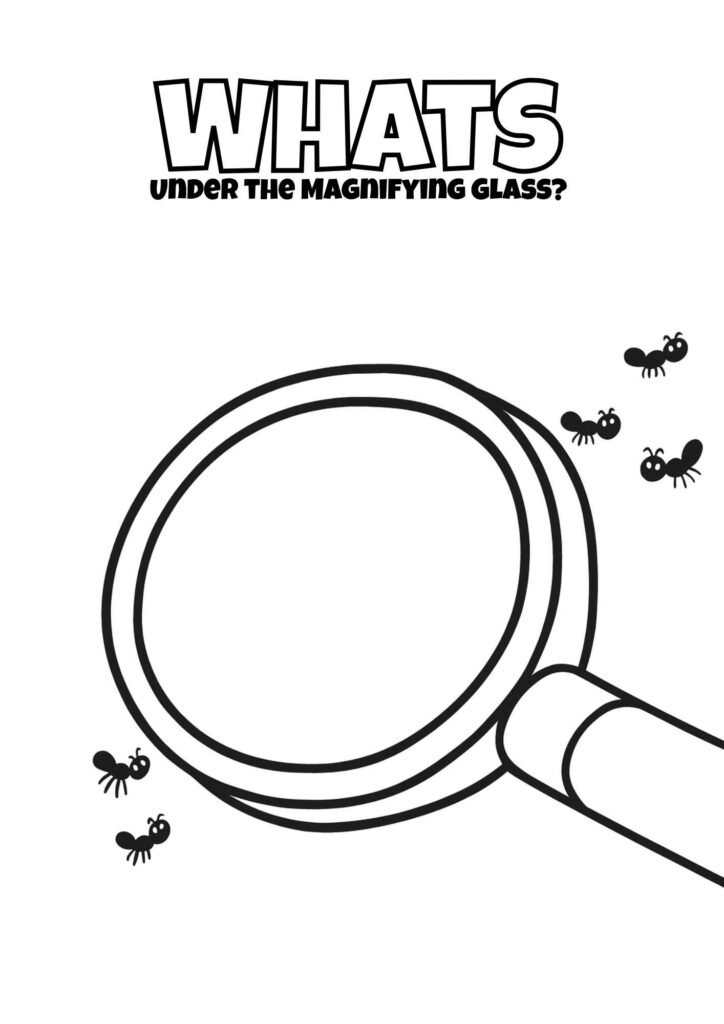
Do you remember the thrill of discovering tiny details in the leaves, bark, or soil around you? The What’s Under the Magnifying Glass – Kids Drawing Worksheet invites children into that wonder. Armed with pencils, observant eyes, and curiosity, they explore the small world — from insects and textures to water droplets and dust particles.
This printable transforms a simple magnifying glass into a gateway for inquiry, observation, and scientific thinking. Children aren’t just drawing; they’re noticing, comparing, hypothesising, and connecting with the natural world.
Turn learning goals into ready-to-run sessions
Browse practical printables and lesson-ready resources for OSHC educators and homeschool leaders.
Why Use a Magnification Drawing Activity?
- Deep observation: When children draw what they see up close, they slow down and notice details — veins, textures, structures — that often go unnoticed.
- Science foundations: This activity encourages classification, structure, and investigation — building early scientific mindsets.
- Creative curiosity: The open-ended prompt lets children choose what object to magnify — from leaves and soil to fabrics or insects — fueling agency.
- Bridging art & science: Observation-based drawing is a powerful bridge between creative expression and empirical thinking.
🧪 How to Use the Printable (with Outdoor & Indoor Options)
1. Gather Materials
- The What’s Under the Magnifying Glass worksheet
- Clipboards or hard surfaces, pencils, coloured pencils
- Magnifying glasses (hand lenses)
- A variety of objects to examine: leaves, bark, stones, flower petals, fabric, small insects (if safe)
- Optional: cameras or phones to take macro photos
2. Introduction & Demonstration
Show an example magnified object (e.g. a leaf vein) and sketch it, thinking aloud: “I see lines, textures, tiny patterns…” Invite prediction: What might we find under the edge of the leaf or beetle’s shell?
3. Observation & Drawing
Let children choose an object and examine it via magnifier. In their worksheet frame, they draw what they see — zooming in, capturing detail, and annotating observations: shapes, lines, textures, colour patterns.
4. Share & Compare
Once drawings are complete, gather and let children share their magnified observations. Ask: “What surprised you?” “What patterns are similar across objects?” “Why might that be?”
5. Extension Ideas
- Macro photography: Let children photograph objects and compare their photo to their drawing.
- Texture rubbings: Use crayon-over-paper rubbings of the same object and compare to magnified view.
- Comparison across scales: Encourage them to draw the same object at normal scale and then magnified — compare detail differences.
- Research link: Ask children to look up the science behind what they drew (leaf cells, insect anatomy, etc.).
📘 Learning & MTOP Connections
| Outcome | Connection through activity |
|---|---|
| Outcome 3 (Wellbeing) | Mindful observation, calm focus, connection with nature |
| Outcome 4 (Learning) | Scientific inquiry, pattern recognition, hypothesis testing |
| Outcome 5 (Communication) | Describing observations, explaining findings, sharing comparisons |
| Outcome 1 / 2 | Honouring children’s curiosity about their world and connecting with environment |
✅ Download & Try It
👉 Download the “What’s Under the Magnifying Glass” Drawing Worksheet
Print it, step outside (or indoors with natural items), and let children become mini-scientists — exploring, sketching, and discovering the beauty hidden in plain sight.
Turn learning goals into ready-to-run sessions
Browse practical printables and lesson-ready resources for OSHC educators and homeschool leaders.